Phuket's remarkable rise from a quiet beach destination to Thailand's leading hub for luxury real estate investment has been driven by ongoing advancements in the island’s infrastructure. This transformation was kicked off when the Sarasin Bridge opened 1967, providing the island with a road connection to the mainland. The Thai government’s investment in Phuket's international airport in 1984 enabled the launch of direct international flights, spurring tourism growth and driving development. Over the years, consistent upgrades to infrastructure have been crucial in supporting the growing property market, which now attracts investors from around the world. Beyond being a favoured location for holiday homes, Phuket has become a highly sought-after place to live, offering top-tier amenities such as international schools, world-class healthcare, shopping centers, and stunning natural landscapes.
Phuket’s infrastructure has been key to its status as a top tourism and real estate destination. Phuket’s international airport links the island to major cities across the globe, with ongoing upgrades set to boost passenger capacity from 12.5 million to 18 million per year. Investments in road infrastructure, such as improvements to Highway 402 and the planned expansion of Highway 4027 by 2026, further enhance connectivity. By 2030, a planned expressway connecting Patong Beach to Phuket Airport is expected to further enhance accessibility. These infrastructure developments, starting with the Sarasin Bridge and Phuket International Airport, have helped Phuket become a prime destination for high-end tourism and real estate investment. In 2024, Thailand expects to welcome 35.32 million international visitors, and continued government investment in infrastructure will play a vital role in maintaining Phuket's long-term property market stability.
Phuket stands out not only for its infrastructure but also for its first-class amenities, far surpassing those of Koh Samui. The island boasts well-maintained roads, reliable utilities, and modern conveniences. Phuket is home to 16 international schools, several top-tier hospitals, and a variety of shopping centers that offer everything from luxury goods to everyday essentials. It also features seven 18-hole golf courses, compared to just one on Koh Samui.
The Marriage of Infrastructure and Tourism
Phuket’s tourism-driven economy has become a vital contributor to Thailand’s GDP, prompting the government to continue its extensive, long-term development program for the island. When we look at the revenue from the islands tourism alone - which excludes the income generated by the associated development of tourist infrastructure, facilities and amenities, and of course, airport revenue - the total revenue from Phuket's tourism sector accounts for nearly a third of Thailand’s total tourist income. In December 2024, tourism revenue in Thailand exceeded170 billion baht, showing an increase compared to the previous month. In 2024, Thailand expects to earn about 1.6 trillion Thai baht from international tourism (Source: Statista). Phuket’s tourism revenue for 2024 is forecast to exceed 500 billion baht, with 246 billion baht recorded in the first half of the year (Source: Bangkok Post). While these figures might seem modest compared to Thailand's overall GDP of approximately 500 billion baht, it’s crucial to consider the broader economic impact. Tourism fuels various other industries, such as construction, real estate, retail, and hospitality, which significantly contribute to the country’s GDP. These interconnected sectors, driven by tourism, amplify Phuket’s economic impact far beyond the direct revenue from tourism.
The relationship between the growth of the tourism sector and infrastructure is a dynamic, self-perpetuating cycle. The more tourism thrives, the more the government of Thailand invests in infrastructure. This continuous feedback loop ensures that infrastructure improvements not only enhance the island’s appeal but also drive further tourism and economic growth. Phuket’s economy plays a crucial role in the national GDP, reinforcing the need for sustained investment in its infrastructure.
Phuket Airport Passenger Movements and Key Infrastructure Milestones (2000–2024)
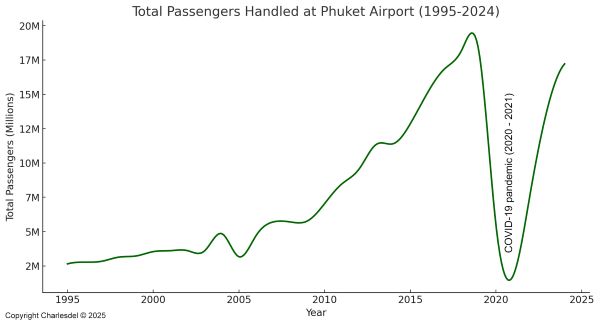
Date source: Wikipedia
Post Covid Recovery
As clearly indicated on the graph above, tourist numbers quickly bounced back after travel restrictions ended, driving the recovery of Phuket’s real estate market. In 2022, 149 villas were sold, surpassing the 131 sold for 2019 and around 3½ times the figure for 2021 (source: Bangkok Post). By 2023, CBRE recorded 400 resort villa sales, four times the yearly average.
Condo sales followed suit – the REIC recording nearly 1,966 sales in 2022, up from 1,425 in 2021. For 2024, early performance figures are very strong, with 787 Phuket villas sold in the first 6 months alone versus 403 for the first half of 2023. Read more about Phuket real estate market trends.
This rapid recovery of the Phuket’s property market was driven by returning tourism supported by continued infrastructure investment.
Tourist-Led Demand
Phuket’s property market, like many emerging markets, initially experienced rapid growth due to untapped opportunities and new demand. However, its ongoing strength and resilience over four decades highlight the advantages of its tourism-driven, cash-led market, including:
• The cash-based nature of Phuket’s property market plays a key role in its stability. Foreign buyers cannot get mortgages from Thai lenders, so most property acquisitions, particularly in the luxury sector, where foreign demand is highest, are cash based. This lack of leverage significantly reduces the risk of market volatility that often affects leveraged markets and ensures greater stability. The inability of non-Thai nationals to obtain mortgages in Thailand is due to the country’s strict ownership regulations for foreign buyers. Foreign nationals are not allowed to own land outright. In the case of freehold properties, foreign investors can hold ownership through a corporate structure, where they own a minority share (typically no more than 49%). The corporate structure requires a minimum of two Thai shareholders for each foreign director, which complicates the ownership process. Alternatively, foreigners may hold properties under a leasehold agreement, but the lease term is capped at 30 years. Both the corporate ownership structure and the relatively short lease term cannot satisfy lending criteria, preventing foreigners from obtaining mortgages in Thailand.
• Diversification in the buyer base helps reduce demand fluctuations, with buyers from various international markets contributing to the market's resilience.
• A large share of high-net-worth investors, who are typically better equipped to weather economic downturns, adds stability to the market.
• The development of the branded property sector in Phuket has transformed the island into Asia’s leading destination for luxury branded residences. Since the creation of Laguna on Bang Tao Beach by Banyan Group in 1988, branded developments have flourished, with notable projects such as Tri Vananda and The Standard Residences driving demand for luxury properties.
• Phuket developers are increasingly tailoring properties to the preferences of high-net-worth international buyers, resulting in a cyclical relationship that strengthens the luxury sector.
• Thailand’s long-term commitment to investing in Phuket’s tourism infrastructure, including hotels, restaurants, and transport links, further fuels the demand for real estate. The continuous investment in infrastructure creates a positive feedback loop, drawing in more tourists and encouraging investment in holiday homes and lifestyle properties.