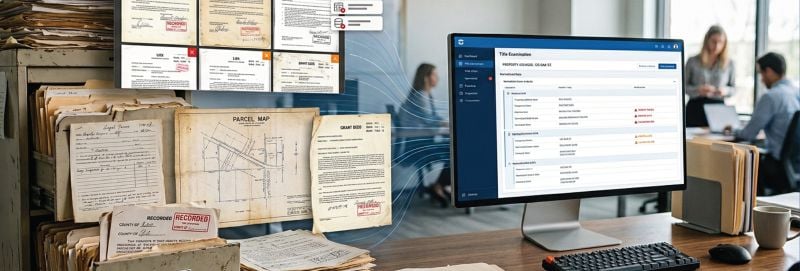
The scope of U.S. title search work spans thousands of county record systems with each of them indexing and recording deeds, liens, and names following own conventions. These local record variations lead to errors the industry is currently solving with automation, IDP and AI.
It's not unusual to find a single chain of title in the US moving across counties, and a long timeline, where documents carry different terms and markers to signify and identify the same parcel and features.
A parcel's original conveyance may have used metes and bounds, while a later mortgage on the same land references a lot and block from a subdivision plat recorded in between.
You may also find a later lien filed against the same property captioned as a materialman's lien, but an examiner trained in another state may recognize it as a mechanic's lien. On top of this, the owner's name may be found recorded in two slightly different forms across two of the instruments in the chain.
None of these variations and differences can be termed as errors. But they cause misses and errors.
While title officers and examiners are long habituated to dealing with these issues as a regular part of their work, trying to scale that work, or reduce that workload with automation and vision AI requires an engineered approach.
It needs customization, and the classification and validation systems have to be trained to accept and respond accurately to jurisdictional variations.
What's helpful to know is about the variations that automated title search preparation systems are taught to catch during intake, extraction, and index reconciliation, and which are still left for you to judge.
Why Manual Review and Basic Automation Miss Title Record Variations
Title officers have always reconciled these issues by hand, but it doesn't scale across thousands of jurisdictions.
Sorting the lien into the right category, confirming the two legal descriptions actually describe the same ground, and reconciling the two forms of the owner's name are all things an examiner can do by hand, on one file.
Doing them on every file, across a jurisdiction's real volume, is where the hours go, and where a mismatch is easiest to miss under deadline pressure.
But basic automation using simple string matching can miss such variations even with a dictionary, when using generic OCR and not using vision AI.
What's worse is that using fuzzy instead of basic string without checks and balances can sometimes pull in so much clutter that you'll have to spend hours running scripts to filter and sort.
“In automated title search and preparation, misses happen from ignoring or failing to catch the variations. One county can file a name as ‘Della Rocca,’ while another may use ‘Rocca Della,’ or there may be a parcel that the recorder and assessor numbered differently.” - Jatin Patel, Sr. Manager of Real Estate Data Solutions at Hitech i2i
How Automation Correctly Handles Common Title Records Variations
A jurisdiction-specific variation, or one based on local conventions, can be found in the instrument itself, at the county recorder's index, or across two separate county offices.
In that third case, the number a recorder assigns to a parcel and the number the assessor assigns may not be the same, or may not be linked clearly to each other.
This fragmentation is so common that RESO now runs a dedicated Universal Parcel Identifier initiative to build a solution for cross-jurisdiction variation issues.
These issues are accurately identified, reconciled or flagged for reviewers in an AI-powered title search automation system during the first leg of the workflow itself, when it does automated data abstraction.
How Title Record Variations Are Reconciled Using Automation and Vision AI
Tagged on Intake: Automated Title Document Classification
The first step to handling variations is to use automated document classification.
Document classification models take off the title examiner's load to map a materialman's lien to mechanic's lien, or a Sheriff's Deed to a Commissioner's Deed or to a Referee's Deed.
All instruments, regardless of naming variations, are correctly tagged with the applicable regional synonym without anyone touching the file, and only genuine non-match cases are flagged for examiner review.
Extracted and Matched: AI Data Extraction for Title Records
Once the instrument is correctly tagged, the next vital point is to check for variations in legal descriptions as title records may follow metes and bounds in states settled before 1785, follow the Public Land Survey System in states settled after, and for platted urban parcels the legal description may use a lot and block.
Automated AI data extraction and abstraction are used to resolve these issues by first structuring the values. Then the system matches the parcel with references found in other parts of the chain and documents. This ensures correct identification of the property and also finds any gaps and misses to flag and route for review, reducing the examiner's workload.
Each instrument's parcel identifier, meanwhile, is tracked as its own field, not assumed to stay stable, or to match automatically, across a recorder's and an assessor's separately maintained systems.
Reconciled in the Index: Automated Title Data Abstraction
Automated abstraction of title documents scores a recorded name by similarity rather than requiring an identical string. It resolves the variations behind a compound surname like Iain Mac Pherson filed as “MAC PHERSON IAIN” and cross-referenced as “PHERSON IAIN MAC” under PRIA's own indexing standards (PRIA, 2022).
A known case shows what happens when that kind of reconciliation is not done: Orr v. Byers, 198 Cal.App.3d 666 (1988). Here, a judgment recorded against “Elliott” was indexed as “Elliot” and “Eliot,” and a later purchaser's title search under the correct spelling never surfaced it. The California Court of Appeal held that the misspelling meant that no notice had reached the purchaser.
Catching Title Chain Gaps Automation Missed Earlier
Many of these variations and issues can’t be fixed in isolation. A missed name variant, a misclassified instrument, or an untracked parcel identifier, each slipping through the net will surface downstream as a gap in the chain of title.
In fact, a 2026 ALTA survey of title professionals found that one of the most frequent curative-work difficulties, cited by 44% of respondents, was that of a missing link discovered partway through a chain.
Here, Automated Title Chain Assembly and a separate Gap Flagging step helps to catch what slips through the earlier steps.
Gap Flagging surfaces every missing release or out-of-sequence entries before the file reaches the examiner.
Every extracted field carries a confidence score and a link back to its source instrument, so the file that reaches the examiner already has its chain assembled and its gaps flagged. Thus, the title examiner’s time can be devoted to review and judgment, and not spent doing assembly.
6 Title Search Checks to Run on Your File
Here are six checks worth running on your own file during title search and production, for the naming, legal-description, indexing, and parcel-identifier variations you'll find across jurisdictions:
-
- Validate an instrument's name against the recording jurisdiction's own taxonomy, and properly separate judicial-sale synonyms (Sheriff's, Commissioner's, Referee's Deed) from a non-judicial instrument (Trustee's Deed).
- Confirm which legal-description system an instrument actually uses (metes-and-bounds, PLSS, or lot-and-block) before relying on it to match the parcel referenced elsewhere in the chain.
- Score two recorded forms of a name by similarity, not by exact string match, before treating them as different parties in the same file.
- Track each instrument's parcel identifier as its own field rather than assuming it stays stable, or matches, across a recorder's and an assessor's separately maintained systems.
- Confirm every retrieved instrument is verified into the chain, not just present in the file, so a gap surfaces as a flagged exception before the file reaches the examiner.
- Require a confidence score and a source-instrument link on every extracted field, so a reviewer can check the reconciliation instead of taking it on faith.
Conclusion
A major part of the delays and liabilities in title search and production come from missing entries, or failing to reconcile local record variations.
These are prevented from causing downstream issues if caught during title preparation, before the file reaches the examiner.
Properly engineered models and systems built for automated title classification, extraction, and abstraction take into account a jurisdiction's actual convention. And scoring every field against a confidence score instead of trusting an exact match reduces the list of issues that reaches a title examiner's table.
About Hitech i2i
Hitech i2i is a Real Estate Document Intelligence Platform developed by Hitech Digital Solutions, a technology company with 35 years of experience serving the real estate industry. The platform is pre-trained on 150+ real estate document types across 1,000+ U.S. county formats, delivering 99% field-level accuracy and 60-70% reduction in processing costs for title search companies and real estate data platforms.