You might have spent countless weeks searching, visiting, and comparing houses, and now, when it’s time to decide what to offer on the home you love, it can certainly feel overwhelming. Like most homebuyers, this stage will be filled with both excitement and nerves for you. Excitement because that perfect house in Brampton could soon be yours. And nervous because the wrong offer price could mean overpaying or losing out on your dream home.
But here’s the good news: deciding the right offer price for a house isn’t as complicated as it seems. You just need to consider the right factors and apply a few strategies to craft a winning offer.
Key Factors to Consider Before Making an Offer on a House in Brampton
1. Market Conditions
The very first thing you should consider before setting your offer price on a property is the housing market you’re buying in. Understanding current market conditions can help you decide whether to make a bold offer or begin with a modest one.
To know where the housing market stands, you must analyse the absorption rate. The absorption rate measures the number of houses sold versus the number of Brampton houses for sale listed within a specific period in the market. Here’s what different absorption rates usually mean:
► 70% - 100%: A Seller’s Market
In a seller’s market, you’ll likely need to make an offer close to the asking price or sometimes even a bit above to stay competitive.
► 40% - 70%: A Balanced Market
You can usually offer near the asking price and still have space to negotiate on minor terms in a balanced market.
► 0% - 40% - A Buyer’s Market
In a buyer’s market, you can confidently start your offers 3% or 7% below the asking price.
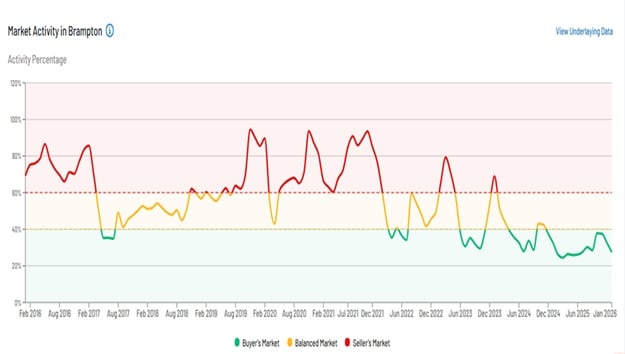 Source – The Canadian Home Housing Market Trends Data
2. Comparable Sales
Comparable sales, also called comps, are Brampton houses for sale that recently sold in the same neighbourhood and share similar size, condition, and features with the property you’re eyeing. Analysing these comps helps you understand what buyers have actually paid for similar homes. Based on this, you can determine a realistic value range for your offer.
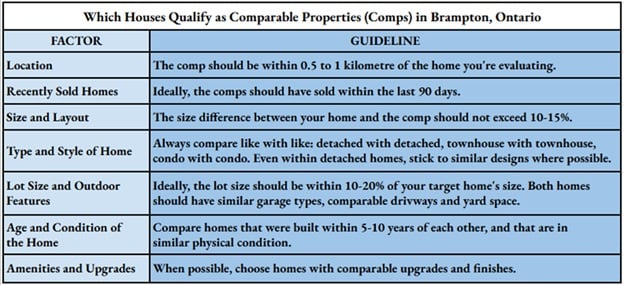
► If most comparable homes sold below the asking price, you can start your offer 2%-5% lower than the list price.
► If similar homes sold at or above the asking price, that means competition is strong. You’ll need to offer closer to or slightly above the asking price for the house.
► If the home’s list price is much higher than recent sales, it’s likely overpriced, giving you room to negotiate.
3. Home’s Listing History
Here’s what to look for in the listing history and what it means:
► Days on Market (DOM)
If most homes in the area sell within 20 days, but this one has been sitting for longer, that’s a sign the seller may be struggling to attract offers and could be open to negotiation. Homes like this that stay on the market for longer give you (the buyer) a golden opportunity, and you can offer slightly below the asking price in this case.
► Cumulative Days on Market (CDOM)
Cumulative Days on Market refers to the total number of days a property has been listed for sale, including any re-listings. A high CDOM (usually 60+ days) signals that the home hasn’t attracted serious offers. In this scenario, you can safely put in a lower offer.
► Price Reductions
If a home’s listing history shows multiple price reductions, it’s a good indication that the seller started too high and is gradually lowering expectations. That’s your cue to make an offer slightly below the current asking price.
4. The Home’s Condition
The home’s condition plays a huge role in deciding what to offer. If the Brampton house is move-in ready with no major repairs needed, offer close to the asking price or slightly above in a hot market. But, if there are serious problems, such as roof damage, plumbing issues, or foundation cracks, you can reduce your offer by the estimated cost of those repairs or ask the seller to handle them before closing.
5. Your Affordability
According to the Canada Mortgage and Housing Corporation (CMHC), your monthly housing costs shouldn’t exceed 39% of your gross monthly income. Hence, this should be your actual spending limit for the house in Brampton. You must consider this affordability and calculate your offer price on the house based on the down payment and current interest rates.
After this step, set a firm maximum - the highest you’re willing to go without stretching your finances. In a hot market, you may need to offer near that limit; in a slower one, start lower and negotiate up.
Winning Strategies to Make Your Home Offer Stand Out from the Rest
Now that you understand what factors to consider before crafting an offer, it’s time to talk about the actual strategies that can help your offer stand out and get noticed by sellers. Here are the strategies that can make your offer competitive and compelling:
1. Keep Your Offer Clean and Simple
When a seller sits down to review multiple offers, they’re naturally drawn to the one that looks easiest to accept. That’s exactly what a clean, simple offer means - one free of unnecessary conditions and clutter.
To keep your offer clean and simple, try skipping minor clauses that only repeat what’s already in the MLS listing, such as confirming appliance inclusions or verifying utilities. However, don’t skip essential protections like a home inspection if you’re unsure about the property’s condition.
2. Strengthen Your Offer with an Escalation Clause
In a competitive housing market where multiple buyers are making offers, an escalation clause can give your offer a serious advantage. It’s a clause you add that automatically raises your offer if another buyer bids higher. For example, you might offer $850,000 for a home but include a clause stating you’ll beat any competing offer by $5,000, up to a maximum of $900,000. This clause keeps your offer competitive without forcing you to negotiate repeatedly or overshoot your budget.
3. Show You’re Serious with an Earnest Deposit
An earnest deposit or a good-faith deposit shows that you, the buyer, have real financial skin in the game and aren’t likely to back out without reason. The earnest deposit can be around 1% to 5% of the home’s purchase price, depending on how competitive the market is. You usually provide the earnest money deposit within 24 hours after the seller accepts your offer.
4. Tailor Your Offer to the Seller’s Needs
Sometimes, the best offer isn’t just about the price - it’s about understanding what the seller really wants. Maybe the seller has already purchased another property and needs to close quickly to avoid carrying two mortgages. In that case, offering a faster closing date, say 15 to 20 days, can make your offer far more appealing.
5. Avoid Making Unrealistically Low Offers
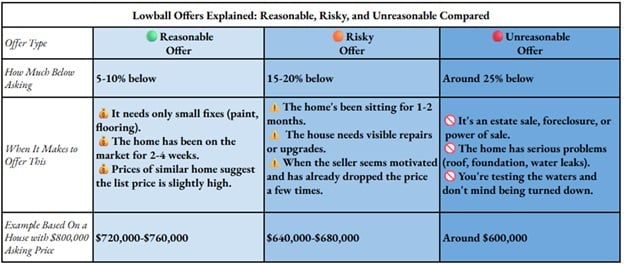
While it’s tempting to test the waters with a lowball offer, going too low can backfire. That’s because an unreasonably low offer might make the seller think you’re not serious or trying to take advantage of them. In cases like this, sellers often reject the lowball offer outright or refuse to negotiate further. That’s why if you’re planning to make a low offer, do it the right way, backing it up with facts to justify your price.
The Next Steps!
Once you submit your offer, the seller gets a fixed time - known as an irrevocable period - to decide what to do next. During this time, the seller and their agent carefully go through every detail in your offer:
• Price
• Deposit
• Conditions
• Closing date
From there, three things can happen. The seller might reject your offer outright, meaning you’ll need to adjust your offer or look for another house. They could also counteroffer, which opens the door for further negotiation.
Or best of all, they could accept it. In this case, once the seller accepts, both parties sign the purchase agreement and move on to meet any conditions. For instance, a home inspection or financing approval. After that, your deposit is safely held in trust, and you’re officially on your way to closing - one giant step closer to owning your dream house in Brampton.