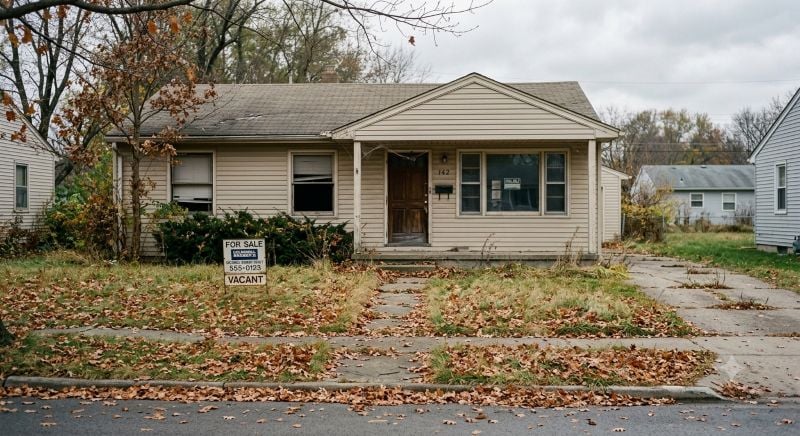
A house that sits empty for 60 days can lose parts of its insurance coverage without the owner receiving a single letter about it. Most homeowners policies include a vacancy clause that limits or excludes coverage once a property has been unoccupied for 30 to 60 consecutive days, according to the Insurance Information Institute. For sellers who move out before the sale closes, that clock starts the day the moving truck pulls away.
Farmer Brown Insurance, a brokerage that has written property coverage in all 50 states since 1996, says the vacancy gap is one of the most common surprises sellers bring to an agent, usually after something has already gone wrong. Here are five things to know before the house sits empty.
1. The vacancy clock starts when you move out
Standard policy forms exclude vandalism outright once a dwelling has been vacant for more than 60 consecutive days, and some carriers use 30. Water damage and glass breakage often ride along in the restrictions. The exclusion applies whether or not the owner ever read that page of the policy.
Picture a seller who relocates for a new job in February and lists the house in March. A supply line lets go in the upstairs bathroom and runs for 11 days before the listing agent's next walk-through. The repair estimate comes back at $47,000. Whether that claim gets paid depends almost entirely on the vacancy language and how long the house had been empty. The Insurance Information Institute puts burst-pipe repairs in unoccupied homes at $10,000 to $70,000 or more, depending on how long the water runs.
2. Vacant and unoccupied are different words to an insurer
A furnished home the owner intends to return to is unoccupied. A home with no contents and no one coming back is vacant. Insurers treat the second category far more strictly, and the deciding factors are usually furniture and intent.
This is one quiet argument for staging. A staged house with utilities running reads closer to unoccupied than a stripped one. But do not rely on a couch to carry your coverage. The policy's own definition controls, so read it or ask your agent which side of the line your listing sits on.
3. Vacant home coverage costs less than sellers expect
A dedicated vacant home insurance policy runs about 0.78% of the home's insured value per year, according to Farmer Brown's pricing data, and that rate covers both the property and the owner's liability. On a $400,000 house, that is roughly $3,120 a year, prorated for the months the home actually sits empty. Three months of an empty listing might cost about $780 to insure properly.
Set that against the $10,000 to $70,000 burst-pipe range above. The premium is a rounding error in most closing statements.
4. Liability exposure grows when the house empties out
An empty listing gets more foot traffic than an occupied home, not less. Agents, photographers, inspectors, appraisers, and buyers all walk through, often unaccompanied by the owner. If one of them slips on an icy step, the owner's liability coverage is what responds, and that coverage depends on the policy still being fully in force.
Practical habits close most of the gap. Keep the heat on through winter to protect the pipes. Have someone walk the property weekly and keep a record of the visits. Photograph the house the day you move out. Dated photos end most arguments about when damage happened.
5. Renovating before listing changes the picture again
Sellers who remodel a kitchen or replace a roof before going to market are running a construction project inside an empty house, and neither a standard homeowners policy nor a vacant home policy is built for that. The product for the project itself is Builders Risk insurance, which for renovation work runs about 65 cents per $100 of project value. A $150,000 pre-sale renovation costs roughly $975 to insure for the year, per Farmer Brown's data.
One quirk worth knowing: Builders Risk premium is fully earned at inception, so there is no refund if the project wraps early. Buy the term the schedule actually needs.
The five-minute call that protects the sale
Before the house empties out, call your insurer, give them the honest timeline, and ask two questions: when does my vacancy clause kick in, and what stops being covered when it does? If the answer leaves a gap between move-out and closing, a short-term vacant home policy fills it for a few hundred dollars.
Sellers spend weeks perfecting a listing. The insurance behind it deserves five minutes.