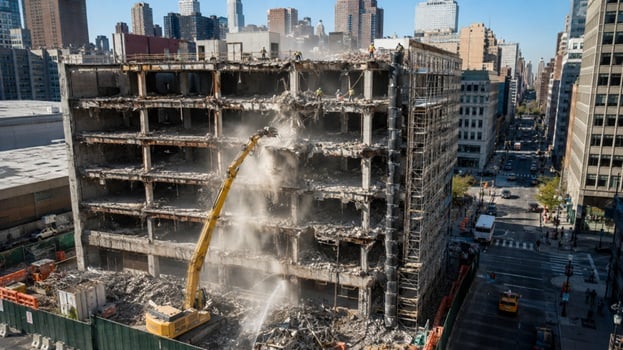
New York City's Department of Buildings issued more than 2,000 demolition permits in 2023 alone, and a significant share of those projects ran over budget, over schedule, or into regulatory enforcement before the first floor came down. The pattern is consistent: a property owner moves fast, skips the preparation work, and discovers mid-project that a compliance step they treated as a formality is actually a hard stop. This guide addresses the decisions that separate commercial demolition projects that execute cleanly from the ones that do not.
Between permit timelines, hazardous material obligations, utility coordination, and the structural realities of working in one of the densest urban environments on the planet, the preparation phase is where commercial demolition projects in New York City are won or lost. Here is what every property owner and developer needs to understand before a contractor sets foot on site.
The NYC DOB Permit Process Is Not Optional and Not Fast
Every commercial demolition project in New York City requires a permit from the NYC Department of Buildings. Full demolitions require a full demolition permit. Partial demolitions, interior gut work, and structural removals each carry their own filing requirements depending on scope. Filing happens through the DOB NOW portal, and the timeline from application to permit approval varies significantly based on project complexity, building classification, and whether the property sits in a landmark district or has active violations on record.
Property owners frequently underestimate permit timelines. For large commercial jobs in Manhattan and the outer boroughs, a realistic window from filing to permit approval runs four to twelve weeks under normal conditions. Projects involving landmark properties, buildings with open DOB violations, or sites requiring special inspections can take considerably longer. Starting contractor conversations before permits are filed, let alone approved, is standard practice. The permit process runs in parallel with contractor selection and preconstruction planning, not after it.
Property owners can review current filing procedures and permit requirements directly through the NYC Department of Buildings. Understanding those requirements before contractor negotiations begin prevents misaligned timelines and last-minute filing surprises.
Hazardous Materials Come First, Not Last
Any commercial building constructed before 1980 in New York City is presumed to contain asbestos-containing materials until a licensed inspector proves otherwise. The NYC Department of Environmental Protection requires an asbestos survey before any demolition or renovation work begins on covered buildings. If asbestos is identified, abatement must be completed by a licensed abatement contractor before demolition crews can proceed. Attempting to skip or compress this step exposes property owners to DEP enforcement, stop-work orders, and significant fines.
Beyond asbestos, older commercial buildings commonly contain lead paint, polychlorinated biphenyls (PCBs) in caulking and electrical equipment, mercury in older lighting and HVAC systems, and underground storage tank residue. The EPA demolition guidelines outline federal requirements that sit alongside New York City's own regulations. In practice, NYC's local requirements are often more stringent than federal minimums, and licensed contractors operating in the city know both sets of rules.
The cost of hazardous material assessment and abatement should be factored into the project budget before any bids are solicited. A demolition bid that does not account for potential abatement costs is not a savings opportunity. It is a sign that the contractor is not pricing the full scope.
Utility Disconnection Is a Coordination Project, Not a Single Call
In New York City, utility disconnection for a commercial demolition involves Con Edison for electric and gas, the local water and sewer authority, and in many cases, telecom providers with active conduit running through the building. None of these disconnections happens on request. Each utility provider has its own scheduling process, and delays from one provider create a cascading effect that pushes the entire demolition start date. Experienced contractors begin utility coordination as soon as the project is approved, not after permits are issued.
Property owners should confirm that any contractor they engage has experience coordinating multi-utility disconnections in New York City specifically. The process in NYC differs materially from suburban or rural markets. In dense urban neighborhoods, gas and water infrastructure often serves adjacent buildings through shared connections, and disconnecting one building without affecting neighboring properties requires precise coordination with the utility provider and, in some cases, temporary service arrangements for those neighbors.
Structural Work in a Dense Urban Environment Requires Specific Experience
Commercial demolition in New York City frequently happens in direct proximity to occupied buildings, active sidewalks, and below-grade infrastructure including subway tunnels and utility corridors. This is not a context where any licensed demolition contractor will do. The project requires a contractor with specific experience in urban structural demolition: mechanical selective demolition techniques, interior floor-by-floor hand dismantling where heavy equipment cannot safely operate, and shoring of adjacent structures to protect neighboring properties throughout the work.
For buildings in Manhattan and the dense commercial corridors of Brooklyn and Queens, a licensed contractor who can both demolish the existing structure and manage the rebuilding phase under a single contract simplifies the project considerably. It removes the transition gap between demolition completion and new construction start, reduces the number of parties coordinating permit filings, and provides single-source accountability for site conditions between phases.
Property owners working on large commercial demolition and rebuild projects should look for contractors who hold unrestricted general contractor licensing in New York and have documented experience on commercial and industrial jobs in the metro area. Firms providing NYC demolition services that cover both structural takedown and rebuild under one contract give property owners project continuity from site clearance through construction completion, which reduces handoff risk and keeps the project timeline tighter.
Safety Compliance Is the Contractor's Obligation and the Owner's Exposure
Commercial demolition is consistently ranked among the highest-risk construction activities by occupational safety regulators. OSHA's demolition standards establish federal minimums for worker protection, structural surveys, and site safety planning. In New York City, Local Law 196 and Site Safety Training requirements add a further compliance layer that applies to all workers on covered sites.
A safety violation on your site creates legal exposure for you, regardless of who is holding the tools. Before signing a demolition contract, confirm that the contractor carries the required general liability insurance and workers' compensation coverage at appropriate limits for the project scope. Confirm that their site safety plan addresses adjacent occupied structures, pedestrian sidewalk protection, and any required NYC Department of Transportation permits for sidewalk closures or street work.
Prevailing Wage and Public Works Compliance
If your commercial demolition project involves public funding, public financing incentives, or is being performed on a property owned by a public agency or educational institution, Davis-Bacon Act prevailing wage requirements likely apply. Many property owners engaged in publicly assisted development projects in New York City are surprised to learn that their contractor's labor practices on site are a condition of their financing or incentive agreement.
Contractors with documented experience on Davis-Bacon and Project Labor Agreement governed jobs bring documentation and reporting discipline that protects property owners from downstream compliance issues with financing bodies, municipal agencies, and union oversight organizations. For mixed-use development projects, publicly supported affordable housing, or any project with institutional tenants, this is a qualification worth asking about directly during contractor selection.
Debris Removal and Site Clearance Require Logistics Planning
Commercial demolition generates substantial volumes of concrete, steel, masonry, and specialty materials. New York City has specific requirements for construction and demolition waste disposal, and responsible contractors maintain relationships with licensed waste haulers and recycling facilities. The volume of material leaving a commercial demolition site, particularly in Manhattan, where street access is constrained, requires detailed logistics planning to avoid DOT violations and neighborhood complaints.
Ask contractor candidates to describe their debris removal process in specific terms: how materials are sorted for recycling, what percentage of demolition material they typically divert from landfill, and which licensed facilities they use for disposal. On projects where environmental documentation matters to stakeholders or lenders, the contractor's waste management records become part of the project file and should be treated as such from day one.
Five Questions to Ask Before You Sign a Demolition Contract
After addressing permits, hazardous materials, and utilities, the contractor selection conversation should work through these questions before any contract is signed.
1. Does the contractor hold a New York State General Contractor license with no height restrictions? Commercial demolition in New York City requires unrestricted licensing. Ask for the license number and verify it against the NYS Department of State contractor license database before the conversation goes further.
2. How many comparable commercial demolition projects has the contractor completed in New York City in the past three years? References from general contractors, developers, or building owners on comparable NYC jobs carry more weight than a general portfolio list.
3. Does the contractor have direct access to the NYC DOB portal for permit filing? Contractors with established DOB relationships and direct portal access typically move through the permit process faster than those filing in New York for the first time.
4. Can the contractor handle the rebuild phase under the same contract? For owners who intend to develop the site after clearance, a contractor with both demolition and general contracting capabilities reduces transition risk and preserves continuity of site knowledge through both phases.
5. What do the contractor's insurance certificates show, and do they name you as additional insured? General liability limits for commercial demolition in New York City should be reviewed by your legal counsel against the project scope before you sign anything.
The Preparation Phase Determines the Outcome
Commercial demolition projects in New York City that run on schedule and within budget share a consistent pattern: the property owner treated the preparation phase as seriously as the construction phase itself. Permits were filed early. Hazardous material surveys were completed before bids went out. Utility coordination started at the beginning of preconstruction. And the contractor selected had a documented track record in New York City, not just in commercial demolition generally.
New York City is not a market where a contractor without local experience figures things out on your timeline. The permit process, the regulatory environment, the physical density of the built environment, and the coordination demands of working alongside occupied buildings and active infrastructure require local knowledge that only comes from having done it here before. For property owners evaluating their options, that local experience is the qualification that matters most and the one that is hardest to fake.