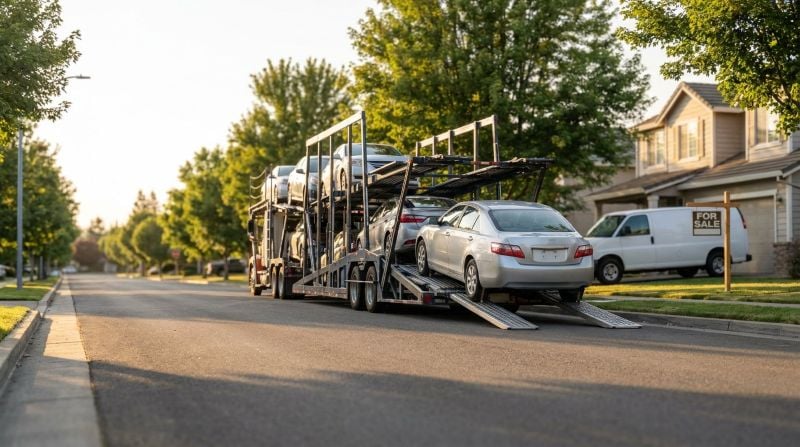
Most people planning an interstate move budget the movers down to the dollar and then treat the car like an afterthought. We'll just drive it. That sentence is where a lot of relocations quietly go sideways, because the car is usually the only piece of the move that has to physically leave on a specific day, arrive by a specific day, and cannot be packed into a box while you wait. And if your household has two vehicles, which about 59 percent of American households do, only one of you can drive one of them.
Spend enough years around dispatchers and load boards, and you learn the car is not the simple part. It's the part with the least slack in it.
Driving It Yourself Is Not Free
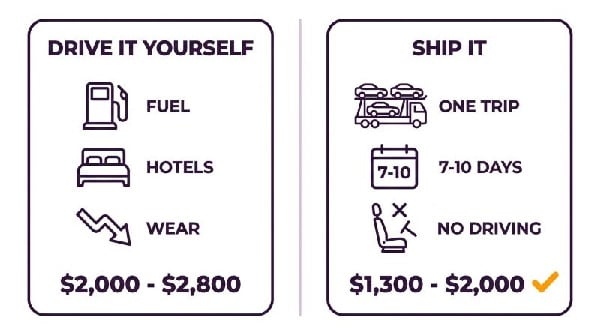
The mental math on driving is almost always wrong because people count gas and stop there. Gas is the small number. A 2,500-mile drive at 25 miles per gallon burns roughly 100 gallons, which at recent national averages is around $400. Then you're looking at four or five nights in hotels at a national average daily rate that crossed $162 this year, plus food, plus five days you are not working, not unpacking, and not at your closing.
Then there's the part nobody counts. The federal business mileage rate sits at 76 cents a mile as of July, and that figure exists because it approximates what a mile actually costs a vehicle once you include depreciation, tires, and maintenance. On 2,500 miles, that's about $1,900 of real cost to the car, most of it in depreciation you don't see until you trade it in. All in, driving one car across the country runs $2,000 to $2,800.
Shipping that same car open carrier is usually $1,300 to $2,000 on a long coast-to-coast lane. The comparison isn't close, and it gets less close the second car you add.
The Cheapest Quote Is the One That Sits
Here's the thing almost nobody explains. The company you booked with probably does not own a truck.
There are roughly 152,000 carriers registered to haul motor vehicles here, and close to 90 percent run six trucks or fewer. A guy with one rig cannot run a national sales department, and you cannot possibly find the one trailer running your exact lane next Tuesday. So brokers sit in the middle, working a load board where millions of vehicles get posted every year.
What that means in practice is that your quote is not a price. It's an opening offer. The broker posts your car with a dollar amount attached, and drivers filter the board by route and pay and pick what makes their week work. If the number is too low, nobody takes it. The broker raises it. That's the whole mechanic.
So when you collect quotes, and one comes back $400 under everyone else, you haven't found a deal. You've found a load that will sit. Real quote spreads bear this out. One comparison of the same New York to Los Angeles move across eleven companies came back between $1,145 and $2,035 for identical service. And the carrier's side has a floor: it costs a truck somewhere north of $2.30 a mile just to roll, spread across seven to ten cars. Below a certain number, the driver is losing money, and he knows it faster than you do.
Your Closing Date Is Not the Truck's Schedule
Median time from contract to closing is about 30 days, and roughly one in seven contracts settles late. Meanwhile, the car has its own timeline that nobody warned you about.
Booking gets you a pickup window, not a pickup date. Usually one to five days on short runs, three to five on long ones. Then transit: a driver is capped at 11 hours behind the wheel inside a 14-hour clock that keeps running while he loads, straps, and inspects each vehicle individually. Realistically, that's 400 to 500 miles a day, less on a day with three residential stops. Coast to coast is seven to ten days of driving after the truck finally shows up.
Stack that against peak season. Something like 45 percent of American moves happen between May and August; June is the single biggest month for closings, and rates on busy corridors run 20 to 35 percent above the winter baseline. Snowbird lanes are worse and directional: southbound in fall, northbound in spring, same trucks, opposite pricing.
Anyone promising you a guaranteed pickup date on a standard booking is promising something they don't control. You can buy a tighter window with expedited service, and it costs 20 to 50 percent more. Giving the dispatcher a five-day window instead of a hard date is the cheapest lever you have.
The Truck Can't Reach Most Driveways
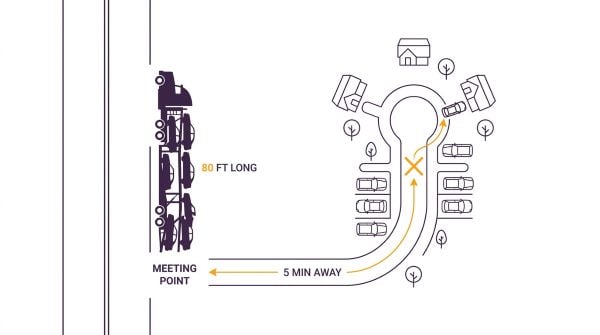
This one surprises people at the worst possible moment. A stinger-steered car hauler runs up to 80 feet long and grosses 80,000 pounds. It does not fit down a cul-de-sac, under low branches, or into a subdivision with parked cars on both sides, and if the driver tries, he risks a trailer he cannot back out of.
That's why door-to-door auto transport means the driver gets as close to your address as the equipment safely allows, usually meeting you at a nearby wide street or a shopping center lot a few minutes away. It is not a technicality; it's how the service has always worked, and a driver who calls to arrange a meeting point is doing the job right, not cutting a corner.
The same physics explains the pricing on trucks and large SUVs. That 10-car hauler is really a 10-slot hauler, and modern vehicles are heavy. Load it with full-size pickups at 6,000 or 7,000 pounds each, and it grosses out at seven or eight units. Fewer cars, same trip cost, higher price per car.
One Piece of Paper Decides Damage Claims
Cargo insurance is not federally required for auto transport the way liability is. Coverage exists, but it's a commercial policy with limits and a deductible, so ask for the certificate before pickup and ask what the deductible is.
The document that actually matters is the bill of lading and the condition report attached to it. Walk the car with the driver at pickup, photograph everything, and make sure every existing scratch is noted. Do the same at delivery before you sign, in daylight if you can. Signing a delivery receipt clean when there's fresh damage is the single most common way people lose a legitimate claim. You have at least nine months to file one in writing, but that paper is your evidence.
Before any of it, spend two minutes looking up the company's operating authority and insurance filings in the federal carrier database. Active authority, insurance on file, and a docket number displayed openly on their website. If those three things don't check out, nothing else about the quote matters.
Book the car the day you have a firm closing date, not the week you're packing. This gets easier with two weeks of lead time and harder with two days.