Buddy punching, the act of one employee clocking in or out for another, may seem like a harmless favor among coworkers. But this practice inflicts serious financial damage. This practice incurs costs for businesses in terms of lost productivity, administrative challenges, and legal risks.
According to the American Payroll Association, businesses lose up to 7% of their total payroll due to time theft. Buddy punching is a major contributor to this. Let's explore the tangible impact of buddy punching and effective solutions to combat this issue.
The Hidden Financial Impact of Buddy Punching
While the concept of buddy punching may seem innocuous on the surface, its economic impact is far from trivial. Beyond direct wage losses from stolen time, buddy punching also leads to plummeting productivity. It also adds to administrative burdens and legal complications.
Quantifying the Direct Costs
• Businesses lose an estimated $400 billion in productivity annually due to payroll fraud. Buddy punching is a part of that according to the American Payroll Association.
• For example, in a company with 100 employees earning $15 per hour, a 2.2% payroll loss translates to $79,200 in stolen wages annually.
These staggering figures offer a quantitative glimpse. Organizations can see the detrimental financial effects of buddy punching. Companies bleed money through this practice.
Exploring the Indirect Costs
Apart from direct wage losses, buddy punching inflicts additional damage in less visible ways:
• Lost Productivity
Employees abusing time clocks spend less time working, hampering output.
• Morale Issues
Blatant policy violations demotivate honest employees.
• Administrative Burdens
Manual monitoring of attendance records increases HR workloads.
Taken together, these indirect costs amplify the economic impact of buddy punching.
Case Studies: Real-World Examples of Buddy Punching Costs
Understanding the immense scope of this issue is one thing, but examining tangible cases drives home its harsh reality:
Mid Sized Construction Firm
This 150-employee business estimated annual losses of $125k from buddy punching. This is based on data from employee interviews. After implementing biometric punch clocks, this figure reduced by 75%.
Big Box Retailer
A recent internal audit discovered 3% of the workforce abusing buddy punching for years. Beyond direct wage loss, this caused the company legal headaches, costing $350k in settlements.
These examples showcase how turning a blind eye devastates the bottom line while opening legal risks.
|
Method |
Effectiveness |
Cost |
Implementation Difficulty |
|
Paper-based |
Low |
Low |
Easy |
|
RFID Cards |
Medium |
Medium |
Medium |
|
Biometrics |
High |
High |
Hard |
Table 1: Comparison of different time tracking methods to prevent buddy punching based on key factors
Technological Solutions to Combat Buddy Punching
Technology provides robust tools to cut the opportunities for buddy punching:
Overview of Time Tracking Systems
A variety of time tracking systems help constrain employees from manipulating attendance records. It can range from rudimentary paper logs to futuristic artificial intelligence programs. Let's analyze some of the most common options:
Paper-based Tracking
The traditional paper timesheet continues to see widespread use for its simplicity and low cost. But ease of falsification by modifying or duplicating records undermine their reliability. Unless subjected to meticulous human audits, paper trails fail to inspire confidence.
RFID Card Systems
Programmable identification cards enable employees to clock in. They simply swipe at sensor-enabled time clocks. The unique ID codes on each card get linked to personnel while preventing general use. But the cards themselves can get stolen or swapped to enable buddy punching. Instead, couple them with access controls like PIN numbers or biometrics for authentication.
Facial Recognition Technology
Video cameras with integrated facial matching algorithms can confirm employee presence. It can be done during shifts without active scanning. Sophisticated AI programs can match faces to payroll databases with over 99% accuracy in seconds. But there are reliability issues in diverse lighting conditions. There is also the inability to discern posture or attention levels. This limits its current applications.
Fingerprint Scanners
Biometric systems that record and match employee fingerprints provide robust safeguards. They have unique biological markers that are almost impossible to fake or exchange. Seamless integration with payroll records enables reliable monitoring of attendance and work durations. But deploying these systems demands significant upfront investments.
Biometric Systems: Effective Guardians
Among available options, biometric technology stands above the rest. It is the most potent guardian against time theft. Deployment of biometric access control systems reduced occurrences of buddy punching by over 68%.
Fingerprint-based systems in particular excel due to the inherent complexity of human fingerprints. Even identical twins have unique prints. They enable accurate matching to identity records in payroll databases. Integrate multi-point identification algorithms into commercial-grade scanners. This further minimizes the already negligible chance of false positives.
Falsification becomes virtually impossible when employees must verify themselves through fingerprint scanning during every clock-in or out event. Confirming presence through biological records provides a tamper-proof solution. Costs currently constrain widespread adoption. But improving technology and economies of scale will enable growing mainstream employment.
Some businesses are struggling to contend with rampant time theft. As such, biometric systems provide a path to recovering lost payroll and productivity. An investment in these technologies can generate impressive savings and returns. Biometrics empowers management to reclaim control over attendance tracking. This is due to the built-in safeguards against fraud.
Software Solutions
Intelligent time clock software goes beyond biometrics to combat attendance fraud. Features include:
• GPS tracking
• Random photo captures
• Automated anomalies reporting
Paired with surveillance, software significantly deters buddy punching schemes.
Legal and Ethical Considerations
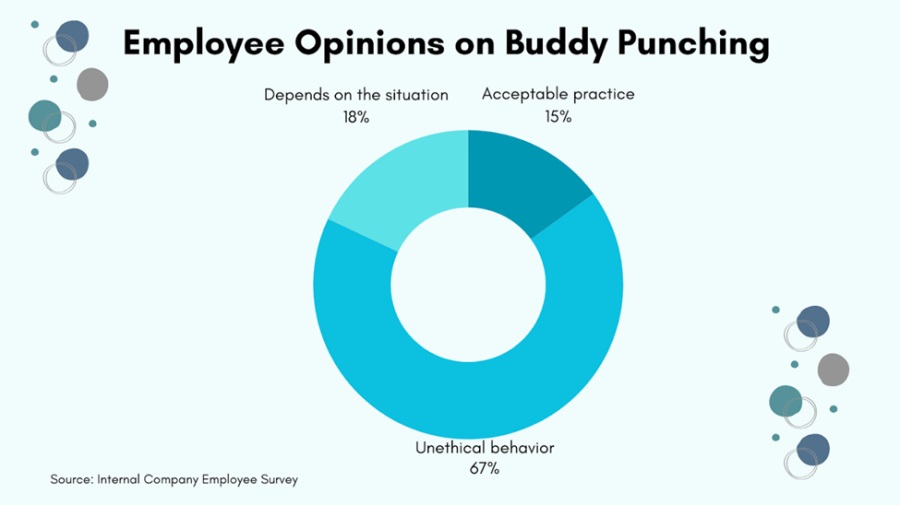
With penalties of six figures, regulatory non-compliance amplifies business risks of buddy punching:
Understanding the Legal Ramifications
As per the Society for Human Resource Management, employers face legal hazards including:
• Lawsuits for wage or labor violations
• Fraud charges
Ignoring this practice spells financial and legal nightmares.
Ethical Dilemmas and Company Policy
Beyond legal compliance, businesses have an ethical obligation to curb buddy punching. After all, payroll fraud erodes workplace trust.
Those aware of violations who remain silent, from employees to HR staff, further perpetuate ethical lapses. Companies must reinforce codes of conduct through concrete action.
Implementing Effective Policies and Training
Technology provides the tools to fight time theft. But human oversight is just as vital via internal protocols and education.
Strategies for Creating Clear Policies
Well-defined company policies on time tracking promote transparency while warning would-be violators. Effective policies usually incorporate:
• Zero-tolerance statements with termination the penalty for assisting payroll fraud.
• Random photo verification of employee presence.
• Required training enrollment on the importance of accurate time reporting.
By removing loopholes, strong official protocols deter buddy punching.
Importance of Employee Education and Awareness Programs
Complementing robust policies, companies must educate all personnel on buddy punching via:
• Training seminars/webinars addressing issues
• Regular digital communications highlighting risks
• Task force teams to handle inquiries
Ongoing education fortifies company defenses.
Measuring the Impact of Anti-Buddy Punching Measures
Once strategies are enacted, quantifying outcomes spotlights where enhancements may be beneficial:
Methods for Tracking Improvements
Metrics to gauge success include:
• Reduced exceptions on payroll audits
• Lower payroll cost as a percentage of revenues
• Increased productivity rates
Statistical measurement demonstrates ROI.
Analyzing the ROI of Implemented Solutions
Revisiting case examples, the construction firm got $94k in yearly savings. This is all thanks to biometric time clocks. At the same time, the retailer expects over $200k in restored payroll dollars.
Analyzing the numbers provides solid evidence to continue funding anti-fraud technology and training.
FAQs: Addressing Common Concerns
Alongside delving into vital issues surrounding time theft, some frequent questions arise:
How can small businesses effectively manage the risk of buddy punching?
Smaller companies have constrained resources. Options catering to their scale exist, including cloud-based time-tracking software. There are also smartphone-enabled biometric systems. The key is embracing solutions congruent with current needs and growth projections.
What are the legal consequences of ignoring buddy punching in the workplace?
Labor regulatory bodies sanction employers who ignore payroll fraud via:
• Fines
• Lawsuits
• Criminal fraud charges in extreme cases
No business can escape legal scrutiny.
Can technology eliminate the risk of buddy punching?
No system has a 100% guarantee. But today's time-tracking solutions reduce vulnerabilities through sophisticated features. Examples of those include randomized photo verification and IP tracking. But technology alone cannot remove risks without corresponding vigilance in the following:
• Company policies
• Audits
• Training procedures
A multi-layered strategy is ideal.
Conclusion
As covered, failure to address buddy punching ushers dire financial and operational hazards. Losses scaling into the hundreds of thousands based on payroll size. Solutions to combat time theft warrant serious focus from business leaders.
Technological innovations are paired with ethical policy enforcement. These provide a potent antidote to attenuate risks. Companies no longer need to resign themselves to rampant fraud. They can leverage cutting-edge systems to realize a healthy return on investment.
Of course, eternal vigilance remains key as unscrupulous elements probe vulnerabilities. But businesses now have economically viable solutions to counter threats. They can foster an ethical culture where fraud finds no sanctuary.
The time is now to assess your company's preparedness. Don't leave the door open for time bandits to drain your bottom line.
Call to Action
To learn more about securing your payroll processes, contact our workforce management experts. You can get a free consultation.