A flat or low-slope roof rarely fails all at once. It wears down gradually, through ponding water, UV exposure, and seam stress, until a building owner is left wondering whether the right move is a full replacement or a less expensive restoration. Getting this decision right saves real money, but getting it wrong, choosing restoration when the underlying structure is already compromised, can end up costing more in the long run than just replacing it properly the first time.
What Restoration Actually Means
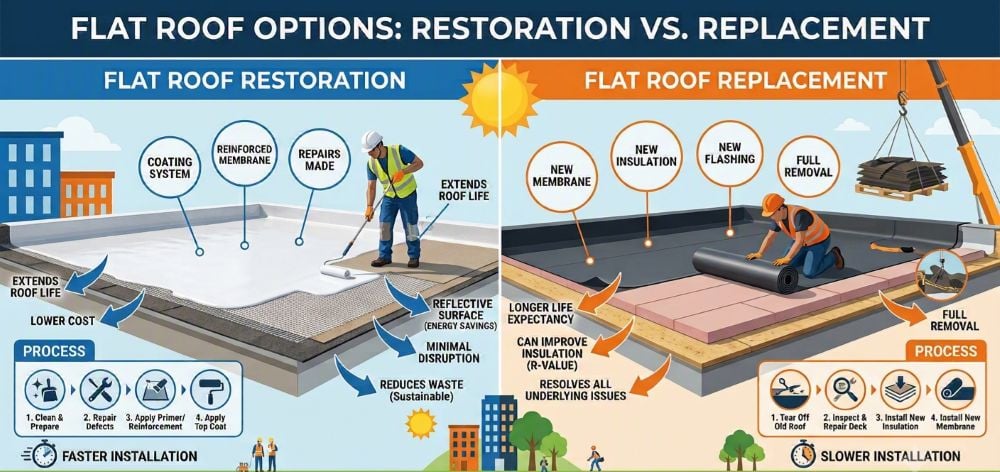
Flat roof restoration typically involves cleaning the existing surface, repairing any isolated damage, addressing drainage issues, and applying a coating system, often silicone, acrylic, or polyurethane, over the existing membrane. Done correctly, this creates a renewed, seamless waterproof layer without the cost and disruption of tearing off the old roof entirely.
Restoration works because it extends the useful life of a roof that's still fundamentally sound, rather than replacing components that don't actually need to be replaced yet.
What Replacement Actually Means
Replacement means removing the existing roofing system down to the deck and installing an entirely new one. This is the right call when the existing system has problems that a surface-level coating simply can't fix, deteriorated insulation, a compromised deck, or damage that's too widespread for targeted repair to address.
The Questions That Actually Determine Which Path Fits
How extensive is the moisture damage? A moisture survey, sometimes done with infrared scanning, reveals how much of the roof has wet insulation or substrate underneath the surface. Isolated wet spots are repairable. Widespread saturation generally isn't something a coating can resolve, since the moisture stays trapped underneath regardless of what's applied on top.
What's the condition of the roof deck? If the structural deck itself has deteriorated, from long-term water exposure, rot, or age, that needs to be addressed at the structural level. No coating system can compensate for a compromised deck.
How old is the existing system relative to its expected lifespan? A five-year-old membrane in otherwise good condition is a strong restoration candidate. A twenty-year-old roof already near or past its expected service life is a different story, even if it currently looks salvageable on the surface.
How severe is the ponding water problem? Some ponding can be corrected as part of a restoration project, by adding tapered insulation or correcting drainage. But severe, longstanding ponding that's already caused significant membrane degradation may point toward replacement instead.
Are the leaks isolated or pervasive? Leaks that can be traced to specific, repairable causes are a good sign for restoration. Leaks appearing in multiple, unrelated areas usually point to a systemic failure that restoration won't fully solve.
A Rough Financial Rule of Thumb
Many roofing professionals use a general guideline: if the cost of repairs needed to prepare a roof for restoration approaches somewhere around 25 to 30 percent of what a full replacement would cost, replacement is usually the better long-term financial decision. This isn't an exact science, but it's a useful sanity check against a restoration quote that's ballooning in scope.
Why a Real Inspection Matters More Than a Visual Estimate
None of these questions can be answered accurately just by looking at a roof from the ground or even walking its surface. A proper assessment, including moisture survey and, where warranted, core testing, gives an actual data-driven picture of what's happening beneath the surface rather than a guess based on visible wear alone.
Getting an Assessment Before Committing Either Way
Because the financial stakes of choosing wrong in either direction are real, restoring a fundamentally compromised roof, or replacing one that didn't need it, it's worth getting a proper inspection before committing to either path. A flat roof restoration project should always start with an honest assessment of whether restoration is actually the right fit for your specific roof's condition, not an assumption based on age alone.