Huntington sits along the Ohio River in West Virginia's Appalachian region, and that geography brings a specific combination of climate stresses: humid subtropical summers, cold winters with real freeze-thaw cycling, and enough annual precipitation, over 40 inches on average, to keep moisture a near-constant factor in roof performance here.
Why Humidity Is a Year-Round Factor, Not Just a Summer One
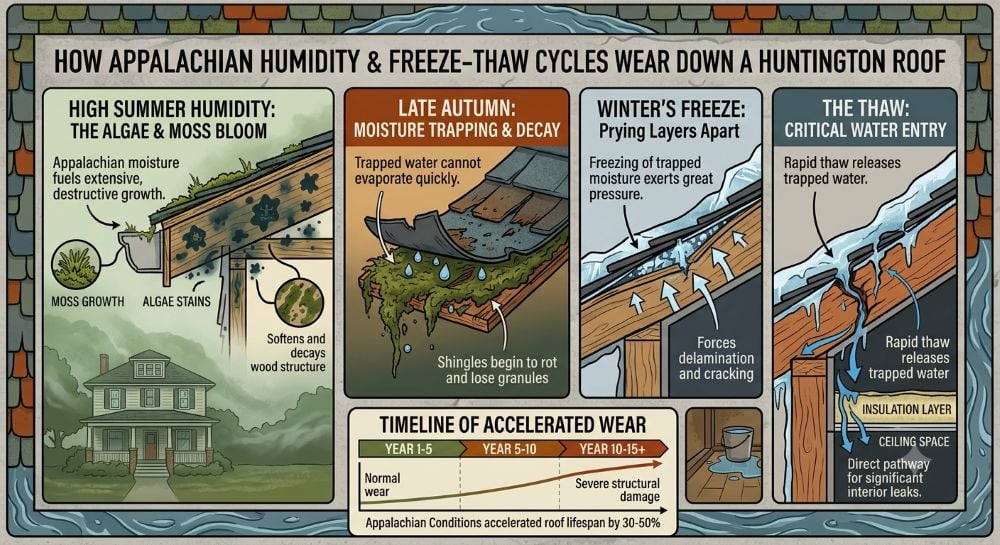
Huntington's humidity doesn't take much of a break across the year, with relative humidity commonly running in the 70s percent-wise for much of it. That consistent moisture promotes algae and moss growth on roof surfaces, particularly shaded, north-facing slopes that don't dry out quickly after rain. It also raises the stakes on attic ventilation, since trapped moisture in a poorly ventilated attic space can lead to mold growth and accelerated deterioration of roof sheathing from the underside, damage that's often invisible until it's fairly advanced.
The Freeze-Thaw Problem Specific to This Region
Huntington gets a real winter, with average January highs only in the upper 30s and enough snowfall, typically over a foot annually, to create genuine freeze-thaw stress. Water that gets into even a minor crack in flashing or aging shingle material expands when it freezes, widening that crack slightly. It then fills with more water on the next thaw and freezes again on the next cold night. Repeated many times over a winter, this cycle is a major contributor to how roofing materials degrade faster here than manufacturer lifespan estimates might suggest, since those estimates are typically based on more moderate testing conditions.
Summer Storms Add Their Own Stress
Appalachian summers bring afternoon and evening thunderstorms with real frequency, and while Huntington isn't typically in the most severe hail corridors of the country, wind-driven storms are common enough to loosen shingles, dislodge flashing, and stress seams on flat or low-slope sections. Storm damage here often isn't obvious immediately, a shingle that's had its seal broken by wind can look fine until the next storm finally works it loose or lets water in underneath.
Why the Combination Matters More Than Any Single Factor
No single one of these conditions, humidity, freeze-thaw, or storm exposure, is unique to Huntington. What makes this region genuinely demanding on roofing materials is the combination of all three happening across the same roof, year after year, with relatively little seasonal relief. A roof here is dealing with moisture-related wear in summer and freeze-thaw stress in winter, essentially year-round pressure rather than a single dominant seasonal threat.
What Tends to Perform Better in This Climate
Given these conditions, a few material and installation choices consistently hold up better for Huntington homes:
-
- Architectural shingles rather than older three-tab styles, since the added thickness and better wind ratings matter in a climate with this much combined freeze-thaw and storm exposure
- Algae-resistant shingle products, which specifically address the moss and algae growth that's common in this level of sustained humidity
- Proper attic ventilation, arguably the single most impactful factor in how long a roof actually lasts here, since it directly addresses the moisture buildup that accelerates deterioration from underneath
- Ice-and-water shield in valleys and along eaves, which provides an extra layer of protection specifically against the freeze-thaw and ice dam risks this region sees each winter
Getting a Roof Built for What This Region Actually Demands
Because the wear here comes from a combination of factors rather than one obvious threat, a roofing approach that only accounts for storms, or only accounts for moisture, misses part of the picture. A roofing contractor in Huntington who understands this specific combination of humidity, freeze-thaw, and storm exposure is better positioned to recommend materials and ventilation solutions that actually hold up to the region's full range of stress, not just the most visible one.