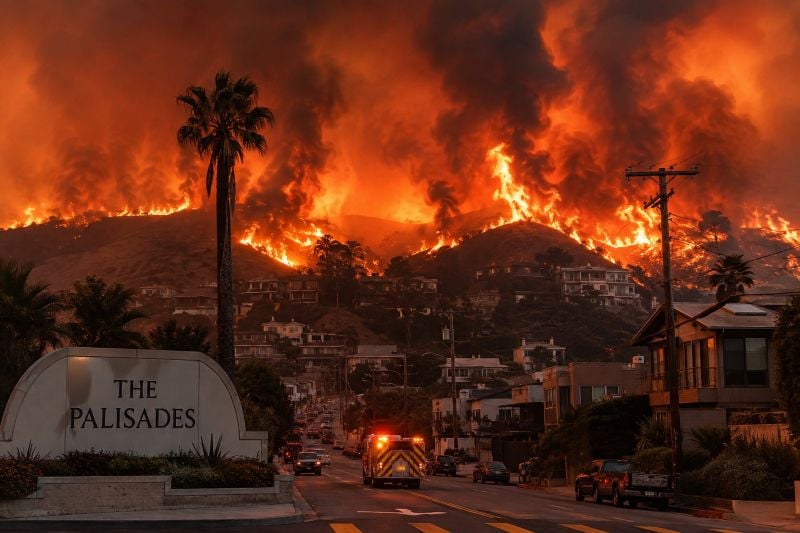
The 2025 Palisades Fire destroyed 6,845 structures and damaged 975 more, according to CAL FIRE's official count. That figure covers all buildings — homes, businesses, schools, and outbuildings — not houses alone. Local reporting has put the residential loss at nearly 6,000 homes, but that's a different measurement than the official structure total.
The fire burned 23,448 acres and killed 12 civilians. It started January 7, 2025, and reached full containment on January 31, 2025, after Santa Ana winds pushed embers rapidly through Pacific Palisades, Malibu, and the surrounding hillsides.
Why "Structures," Not "Houses"
CAL FIRE counts every built structure in the fire footprint — single-family homes, apartments, mobile homes, garages, sheds, guesthouses, businesses, schools, and civic buildings — not just houses. Its damage inspection teams completed inspections for 100% of structures in the footprint, which is why the final number (6,845) is more reliable than early estimates.
Losses included the Palisades branch of the LA Public Library, Palisades Elementary, Marquez Elementary, and the entire Pacific Palisades Bowl Mobile Estates community. None of those are single-family houses, which is part of why a "houses" count differs from the structure total. Estimated property damage runs around $22 billion.
Local coverage describing "nearly 6,000 homes" lost is a reasonable estimate, but it depends on definitions — does a 12-unit apartment building count as one home or twelve? Both figures are valid; they're just measuring different things.
Why the Numbers Vary Across Sources
Early counts grew as inspections progressed: about 1,900 structures by January 8, roughly 3,501 by February 4, and a final range of 6,837–6,845 once every parcel was checked. Older articles captured accurate snapshots for their moment, not errors.
CAL FIRE's DINS (Damage Inspection) system sorts structures into destroyed, major, minor, affected, inaccessible, or no damage. "Destroyed" generally means more than 50% damage. The 975 "damaged" structures include everything short of destroyed, and some of those may still hide serious smoke, heat, or water damage not visible at a glance.
Where the Damage Happened, and How to Check a Property
The fire spread through Pacific Palisades, Malibu, Topanga, and the Santa Monica Mountains, with damage patterns typical of wind-driven wildfire — some blocks lost nearly everything while nearby blocks were largely untouched.
For address-specific status, use official sources rather than news maps or social media. LA County Recovers hosts the Palisades Fire recovery hub with damage maps, debris removal guidance, and permit-center information. A home left standing isn't automatically safe — smoke, ash, water, or electrical damage can require professional evaluation before move-in.
What the Numbers Mean for Homeowners
Practical steps include confirming your DINS classification, photographing everything, keeping all receipts and correspondence, filing your insurance claim promptly, avoiding unsafe debris, and using licensed professionals for inspections and repairs.
Insurance recovery has been slow — fewer than 20% of total-loss claims had closed by December. Roughly a third of insured respondents were covered by State Farm or the California FAIR Plan, which alone carried about $6 billion in exposure from the January fires. More than 600 total-loss properties have already been sold rather than being rebuilt by their original owners.
Once a property's status and claim are moving, the next question is usually what kind of work the structure needs. Homeowners often compare public recovery resources and alternative housing options with licensed fire-restoration and reconstruction providers such as Golden Coast before deciding whether a structure needs remediation, repair, or a full rebuild.
Palisades and Eaton Fires: Discussed Together
The Palisades Fire was part of the broader January 2025 LA wildfire disaster, alongside the Eaton Fire in Altadena and Pasadena. Together, the two fires burned 37,469 acres, destroyed roughly 16,255 structures, and displaced about 205,000 people.
Recovery has moved slowly in part because both fires draw on the same regional pool of contractors, engineers, inspectors, and insurers. The U.S. Army Corps of Engineers managed much of the large-scale debris removal needed before rebuilding could begin.
Because the Palisades and Eaton disasters strained the same regional recovery ecosystem, residents may also find it useful to compare area-specific restoration resources for neighboring fire zones, such as this Altadena-focused page from Golden Coast, when weighing what post-fire assessment and reconstruction services typically cover.
Rebuilding After the Fire
Rebuilding is still early. About 26.7% of destroyed structures across the fire areas had received building permits, but only 0.47% had completed reconstruction and occupancy approval. In the Palisades specifically, fewer than a dozen homes had been fully rebuilt by July 2026, with roughly 900 under construction.
The rebuild path generally moves through: debris removal (the EPA ran its largest-ever hazardous-material removal effort, covering 2,386 Palisades properties), insurance settlement, permitting, code-compliant design, and finding available contractors.
New construction must meet California's Wildland-Urban Interface fire codes, which govern ignition-resistant materials for vents, roofs, decks, windows, and siding. CAL FIRE's defensible-space framework — Zone 0 (five feet), Zone 1, and Zone 2 (out to 100 feet) — is central to reducing risk; research after the Palisades and Eaton fires found that more than 25% fuel coverage in Zone 0 pushed damage risk to nearly 90%.
Frequently Asked Questions
How many buildings burned down in the Palisades Fire?
CAL FIRE reports 6,845 structures destroyed and 975 damaged, covering all building types — not just houses. Local reporting describes the residential loss as nearly 6,000 homes.
How many houses were rebuilt from the Palisades Fire?
Fewer than a dozen by July 2026, with about 900 more under construction and roughly 26.7% of destroyed structures permitted.
How many homes were burned in Altadena?
Altadena's losses came from the separate Eaton Fire; together with the Palisades Fire, the two destroyed roughly 16,255 structures.
Why did Jonathan Rinderknecht start the fire?
CAL FIRE lists the cause as arson, and the Department of Justice indicted Jonathan Rinderknecht in October 2025 on federal charges tied to the fire. These remain charges, not a conviction, and no motive should be treated as established fact while the case is pending.