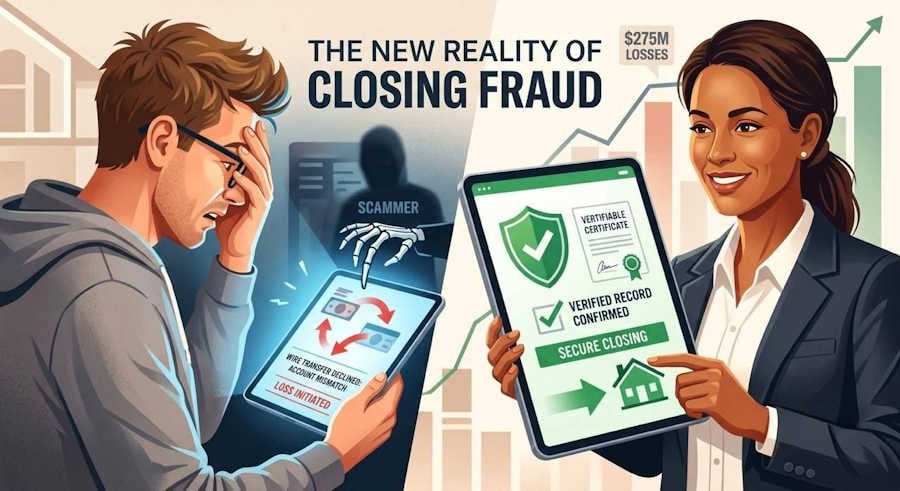
Closing fraud has stopped being a rare horror story and become a line item. The FBI's Internet Crime Complaint Center reported that real-estate fraud losses climbed from $173 million in 2024 to $275 million in 2025, across 12,368 complaints, a 58% jump in a single year. For a buyer, those are not statistics. They are a down payment that left for the wrong account on the morning of closing.
Almost every one of these cases runs through the same mechanism. Business email compromise, the second-largest category by loss at $3.04 billion across 24,768 complaints, begins when an attacker quietly gains access to the email of an agent, title officer, or closing attorney and watches the transaction thread. At the right moment they send wire instructions that look exactly like the real thing. Criminals are now layering AI on top of this to make the messages and the supporting documents more convincing, and the IC3 logged more than 22,000 complaints referencing AI in 2025.
The weakness the fraud exploits is trust in documents and instructions that simply look legitimate. That is the case for a real estate document signing platform that produces a verifiable record of every signed disclosure and agreement, rather than a chain of forwarded PDFs anyone can alter. When the signed file carries its own tamper-evident, time-stamped proof, a swapped page or a doctored instruction stops being invisible.
Picture how this plays out on closing day, the moment the fraud is built for. The buyer is expecting to wire funds and is keyed up to act fast. An email arrives, on the right thread, in the familiar tone, with updated account details and a note about a last-minute change at the bank. Nothing about it looks wrong, because nothing about it is supposed to. The only reliable defence at that instant is not a sharper eye; it is the ability to confirm that the instruction and the documents behind it match the verifiable record of what was actually signed and agreed earlier in the deal.
The most useful place to apply this is the instant before money moves. Before releasing a wire, a buyer or closer should be able to check the payment instruction against the verifiable record of what the parties actually agreed, rather than against a memory of an earlier email. If the account details match the signed instruction on file, the transfer proceeds; if they do not, the mismatch stops it. That single checkpoint, run at the moment of highest risk, is where a verifiable trail earns its keep, because it turns a judgment call made under time pressure into a simple comparison against a record that cannot be quietly rewritten.
This is not a niche scam. The same IC3 report counted more than a million complaints of cyber-enabled crime in 2025 and losses above $20.8 billion, up 26% on the year. Real-estate fraud is one lane of a record wave, and the 58% single-year rise in its losses shows it is a lane criminals are actively widening. The reason is simple economics: a property transaction moves a very large sum on a known date, which makes it one of the most attractive targets a fraudster can find.
The point is prevention, because recovery is a coin toss. The FBI's recovery team initiated roughly 3,900 incidents in 2025 and froze $679 million of $1.16 billion in attempted thefts, a 58% success rate, which means a large share of stolen funds never comes back. Worse, that rate reflects money stopped before it left the domestic banking system. Once a wire reaches an overseas account, the odds of recovery fall close to zero. Catching an altered document before money moves is worth far more than chasing it afterward, and verifiable provenance is what makes the catch possible.
Wire diversion is not the only vector, either. Seller impersonation and deed fraud work the same way from a different angle: a fraudster poses as an absentee or vacant-land owner, produces documents that look authentic, and tries to sell or borrow against a property they do not own. The defence is the same in principle. When a signed disclosure or transfer is tied to a verifiable, identity-linked record rather than a loose PDF, an impersonated signing has to clear a bar that a convincing-looking attachment simply cannot, and the discrepancy surfaces before a title changes hands.
For the people running transactions this is practical, not theoretical. With 65% of real-estate transactions now using digital signing, the documents are already electronic. The missing piece is proof that the disclosure a client signed is the exact one in the file, on the date claimed, so that "did you send this, and is it unchanged" is answered by the record rather than by a phone call placed in a panic.
There is also the question of who absorbs the loss, and the answer is rarely tidy. When a wire goes astray, buyers, agents, title companies, and closing attorneys spend months arguing over responsibility, often through errors-and-omissions claims and litigation that cost far more than the original transaction earned. A verifiable trail does more than stop the theft; it documents who sent what and when, so a professional who acted correctly can prove it instead of being dragged into a dispute about a message they never wrote.
It is worth being honest about why warnings alone have not fixed this. Agents already paper every file with wire-fraud advisories, and the fraud still lands, because it does not prey on ignorance. It preys on the fact that a document or an instruction is trusted on sight. Telling a buyer to be careful does nothing to change what the buyer is actually looking at. A verifiable record changes the thing itself, which is why systemic proof outperforms one more caution added to a stack of disclosures nobody reads.
The protection compounds when it runs across the whole transaction rather than a single document. Disclosures, addenda, amendments, and the final settlement statement each pass between several parties and each present an opportunity to insert an altered page. If every signed item in the file carries its own verifiable, time-stamped proof, the record of the deal becomes internally consistent: any version that does not match is visible immediately, rather than surfacing weeks later when the money is already gone.
The stakes are personal in a way most fraud is not. For a buyer, a home is usually the largest transaction of their life, and the loss of a down payment is often unrecoverable. Consumer surveys from the National Association of Realtors have found roughly one in five people targeted by some kind of scam attempt, and real-estate consumers are squarely in that group. An agent or closer who can show a client a verifiable trail for every document is not just reducing risk; they are offering the kind of assurance that increasingly wins the business.
It is worth being precise about what a verifiable record actually changes, because it is not magic. It does not stop an attacker from sending a convincing email. What it does is remove the email's power to override the documents. A doctored instruction or a swapped disclosure no longer stands on its own authority; it has to match a record that cannot be quietly edited, and when it fails to match, the discrepancy is the alarm. The fraud depends on documents being taken at face value, and verifiable provenance is precisely what withdraws that face value.
None of this asks buyers or agents to change how they work. The documents are already signed electronically, and the proof simply travels with the file rather than living in a separate system nobody checks. There is no new habit to learn at the closing table, which is exactly why it is realistic to adopt across the ordinary transactions where these losses actually happen.
Agents and title companies that can demonstrate a verifiable history for the documents in a deal protect their clients and themselves at the same time. In a market where a convincing fake email and an altered attachment can divert a wire in minutes, the professionals who can prove a document is the one that was signed are the ones whose closings actually close.
As fraud losses keep climbing and the fakes keep getting better, the agents and closers who treat verifiable documents as standard practice, rather than an upgrade, will be the ones clients trust with the largest transaction of their lives.
None of this replaces the human habits that already help, like calling a known number to confirm a wire before sending it. It makes those habits reliable. A phone call verifies a person; a verifiable record verifies the document, and closing fraud succeeds precisely in the gap between the two. Pairing a quick call with a record every party can check turns the riskiest few minutes of a transaction into a step that either confirms cleanly or refuses to proceed, which is exactly the outcome a buyer wiring their life savings deserves.