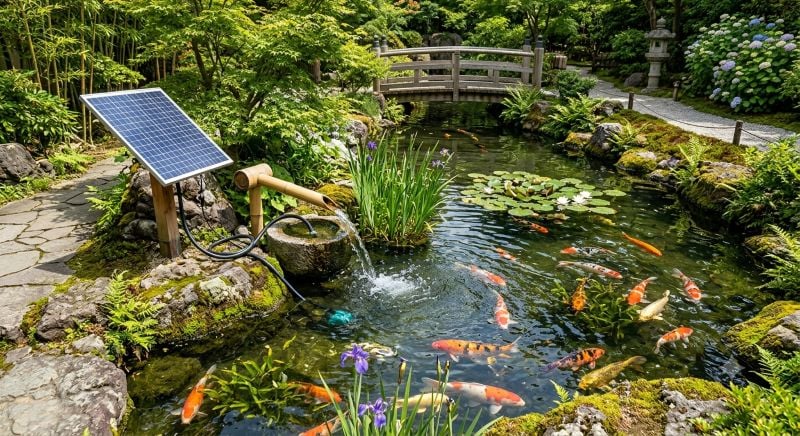
A solar water pump for fountain use turns a still, lifeless basin into moving, oxygenated water, without a single foot of buried electrical cable. Stagnant water is where the trouble starts: algae takes hold, the surface develops a sour odor, and koi grow stressed as dissolved oxygen falls. At PopoSoap Solar, we supply energy-efficient solar water pumps and pond filtration systems to customers across the USA, from small patio fountains to heavily stocked koi ponds. Whether you need gentle circulation or a full koi pond filter with mechanical and biological stages, the right pairing keeps water clear, healthy, and worth looking at.
Why Choose a Solar Water Pump for Your Fountain?
The appeal of solar is mostly about what you don't have to do. There's no trenching across the lawn, no outdoor outlet to add, no electrician's invoice, and no monthly line on your power bill, the panel produces exactly what the pump consumes, so running cost is effectively zero. Placement becomes a design decision rather than an electrical one: if the panel gets sun, the fountain can go there. Maintenance is lighter too, with no transformer or buried wiring to fail, and with nothing drawing from the grid the whole feature runs carbon-free.
The trade-off is output that tracks the weather. A direct-drive pump slows when clouds pass and stops at dusk, fine for a decorative fountain, less so if you want steady flow, in which case choose a battery model.
How solar fountain pumps work
Sunlight hits the photovoltaic panel, which generates DC current. That current feeds a brushless DC motor directly, no inverter required, and the impeller pushes water up the riser to the nozzle. Battery models charge during peak sun and discharge after dark or through overcast stretches, typically giving two to six hours of run time.
Every solar water pump for fountain use is built with a brushless motor for quiet, long-lasting operation.
Understanding Koi Pond Filtration
Koi are not goldfish with better marketing. A mature koi can reach two feet and eats accordingly, so a koi pond carries a far heavier waste load per gallon than an ornamental pond holding a few small fish. That waste breaks down into ammonia, and koi are unusually sensitive to it; levels a hardier species would shrug off cause gill damage and suppressed immunity. Filtration here isn't an accessory; it's life support.
Effective koi filtration works in stages:
-
- Mechanical — screens, brushes, or foam pads trap solids before they decompose. This stage needs cleaning most often.
- Biological — a high-surface-area media bed hosts nitrifying bacteria that convert ammonia to nitrite, then to far less toxic nitrate. The colony takes four to eight weeks to establish and must never dry out or be rinsed in chlorinated water.
- UV clarification — an ultraviolet lamp kills free-floating algae, clearing the green haze the first two stages leave behind.
Skip a stage, and it shows up within a season as cloudy water or sick fish. PopoSoap Solar's koi pond filter systems combine mechanical and biological stages so you don't need to buy separate units.
How to Choose the Right Pump and Filter
Sizing is where most first-time buyers go wrong, usually by choosing on price rather than on flow. Work through these five factors in order:
|
Factor |
What to look for |
|
Pond/fountain volume |
Full turnover every 1–2 hours (koi: hourly) |
|
Flow rate (GPH) |
Match to your filter's rated capacity |
|
Head height |
Vertical lift from pump to nozzle or filter inlet |
|
Panel wattage |
Higher for taller spray patterns or partly shaded yards |
|
Battery backup |
Needed for night or low-light operation |
Head height is the one people forget. A pump advertised at 1,200 GPH is rated at zero lift; push that water up four feet and real output can fall by a third. Read the manufacturer's flow-versus-head curve, not just the headline number.
Sizing rule of thumb
Turn the whole pond over at least once an hour for koi. A 1,000-gallon koi pond therefore needs roughly 1,000 GPH minimum at your actual head height, and there's no penalty for going above that.
Climate and sunlight considerations
Panel output depends on where you are. In the Southwest and Southern California, a modest panel is plenty year-round. In the Pacific Northwest, Upper Midwest, and Northeast, size up on wattage and expect shorter winter run times. Everywhere, face the panel south and check for tree shade at 10 a.m. and 3 p.m., not just at noon.
Product listings on our site show GPH and head-height specifications for each model, so you can size against your pond volume before you order.
Installation and Maintenance Tips
Mount the panel where it faces south with nothing shading it through the middle of the day, and keep the cable run short to limit voltage drop. The pump itself sits below the waterline — most models are submersible and rely on surrounding water for cooling, so running one dry can destroy it in minutes.
For upkeep, rinse the pre-filter or foam pad weekly with pond water, and never wash biological media in tap water; chlorine kills the bacterial colony you spent weeks growing. Clear debris from the impeller monthly. In freezing zones, pull the pump, drain it, and store it indoors for the winter, or keep it running deep enough to stay below the ice line.
Each Solar pump ships with a setup guide, and our support team can help you match a pump to your existing filter.
Why Buy Solar Pumps and Pond Filters From PopoSoap Solar
PopoSoap Solar ships nationwide across the USA, with stock held on fast-moving fountain and koi models. Every pump and filter is built for outdoor duty, with UV-stable housings, sealed brushless motors, weather-rated panels, and backed by a manufacturer warranty plus a straightforward returns policy.
The range runs from compact birdbath and patio fountain pumps up to full koi pond setups with staged filtration, so you can scale as your water feature grows. Checkout is secure, verified customer reviews are published on each product page, and our team answers sizing questions before you buy rather than after.
FAQ’s
Do solar fountain pumps work on cloudy days?
Yes, at reduced output. Direct-drive models slow noticeably; battery-backed models keep a steady flow using stored charge.
What size koi pond filter do I need for a 1,500-gallon pond?
Choose a filter rated for at least 1,500 gallons with a pump moving roughly 1,500 GPH at your actual head height.
Can a solar pump run 24/7?
Only with battery storage, and typically for two to six hours after dark. Continuous operation needs a hybrid or mains-assisted setup.
Does the pump filter the water, or do I need a separate filter?
Most pumps include only a debris pre-filter. Koi ponds need a dedicated mechanical and biological filter.
Do these solar fountain pumps ship across the USA?
Yes, they ship to all 50 states.
Ready to Get Started?
Clear water, healthy koi, and no electricity bill all come down to matching the right pump to the right filter. Browse the Solar collection of solar water pumps and koi pond filters and order today; their team is on hand if you'd like help sizing your setup.