For years, many resale agents and resale buyers operated from the same assumption: new homes cost more.
That assumption is no longer safe.
The National Association of Realtors recently reported that June 2026 existing-home sales brought a median sales price of $440,600, an all-time high, while inventory remained tight at 4.6 months of supply. NAR Chief Economist Lawrence Yun warned that without consistent gains in inventory, home prices can accelerate and long-term affordability can suffer.
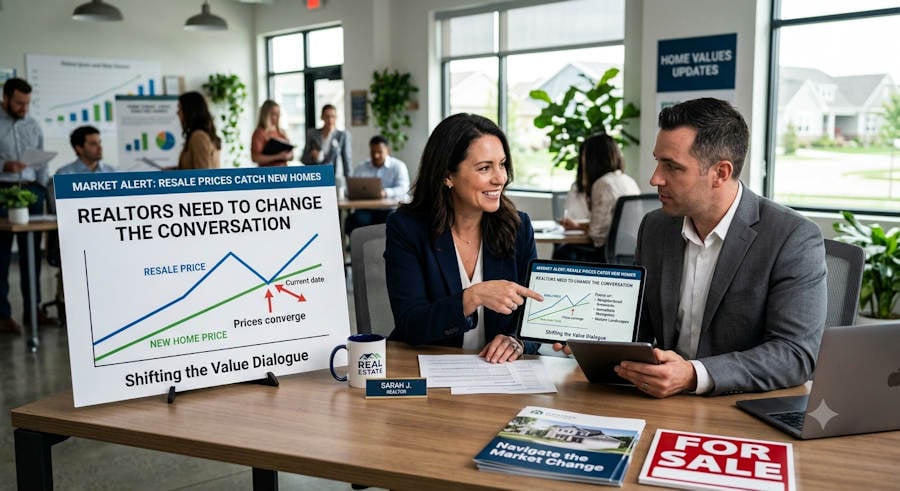
At the same time, the price relationship between new and existing homes has changed in a way Realtors cannot ignore. NAR’s own coverage described this as an “unprecedented” shift, noting that buyers may still assume new homes are too expensive even though that is no longer always true. In April 2025, the median new-home price was $407,200, while the median existing-home price was $414,000.
NAHB’s Eye on Housing, using U.S. Census Bureau and National Association of Realtors data, reported that in the first quarter of 2026 the median price for a new single-family home was $403,200, slightly below the $404,600 median price for an existing home. It also noted that existing-home prices have exceeded new-home prices in six of the past eight quarters.
To me, this means one thing: more resale shoppers will become new-home buyers, whether their Realtor is prepared or not.
That is the business issue.
A buyer who begins the process looking at resale homes may now discover, through online search, builder advertising, mortgage incentives, or AI recommendations, that a new home is no longer out of reach.
In a growing number of cases, the builder may offer closing-cost assistance, design incentives, or mortgage-rate buydowns that make the new home more competitive. Realtors who are left out of this conversation will lose sales they should have made.
NAR’s article noted that builders have been responding to affordability pressure with price cuts and incentives, including closing-cost help, upgrades, and mortgage-rate buydowns. That matters because buyers do not buy only based on the sales price. They buy based on monthly payment, available cash, timing, confidence, perceived value, and the feeling that the home solves their problem.
That is why Realtors need to stop treating new construction as a separate category that only matters after resale options fail.
New-home inventory and affordability should now be part of the original buyer-qualification conversation.
When a Realtor sits down with a resale buyer, the questions should no longer be limited to bedrooms, baths, location, school district, commute, and price range. The Realtor should also ask:
“Would you consider a new home if the monthly payment, timing, and location made sense?”
That one question may keep the Realtor in the center of the transaction.
The risk is not that buyers will suddenly stop wanting resale homes. Many will still prefer established neighborhoods, mature landscaping, shorter commutes, or the character of older homes. The risk is that the buyer will quietly compare resale and new construction without the Realtor guiding the process.
That risk is about to grow because of AI.
The AI home shopper is not going to think in old industry categories. AI will not say, “This buyer is working with a resale agent, so I should only recommend resale homes.”
AI will compare options. It will look at price, estimated payment, incentives, commute, schools, taxes, HOA fees, builder reputation, reviews, floor plans, energy efficiency, closing timelines, and likely negotiation room. Then it will recommend what appears to be the best fit.
That means a buyer may ask AI a very practical question:
“Should I buy this 12-year-old resale home at $425,000 or this new construction home at $415,000 with a builder rate buydown?”
If the Realtor is not prepared to answer that question, the buyer may move toward the builder without them.
This is where judgment matters.
AI may produce a list of pros and cons, but it will not automatically understand the buyer’s deeper motivation, family pressure, fear of overpaying, timing concerns, financing reality, or emotional objections. That is still the Realtor’s job. But the Realtor cannot provide that judgment if new construction was never part of the conversation.
Realtors should also be qualifying resale buyers for new homes much earlier.
That does not mean pushing every buyer toward a builder. It means knowing whether new construction belongs in the consideration set.
Can the buyer wait for completion? Do they need a quick move-in home? Are they comfortable with an HOA or CDD fee? Do they understand builder contracts? Have they compared monthly payment after incentives? Do they know how lot premiums, upgrades, deposits, and closing costs work? Would a builder’s mortgage incentive make a home affordable that otherwise looked out of reach?
These are not side issues anymore. They are buyer representation issues.
The second adjustment Realtors need to make is relational. They need to start building relationships with onsite sales consultants before they have a buyer in the car.
Too many Realtors treat onsite agents as competitors. That is a mistake. The onsite sales consultant knows inventory, incentives, construction stage, lot availability, buyer objections, builder policy, registration requirements, and upcoming changes.
A Realtor who has a respectful relationship with onsite sales consultants can better protect the buyer, protect the commission, and protect the relationship.
The best time to meet an onsite consultant is not when your buyer is already standing in the model home asking questions. The best time is before that, when you can introduce yourself professionally, learn the community, understand the process, and ask how they prefer Realtors to register and work with buyers.
That is a judgment move, not a technology move.
The third adjustment is strategic. Realtors need to understand that the buyer’s search is becoming blended. The old line between resale and new construction is fading because the buyer’s real question is not “new or used?” The buyer’s real question is, “Which home gives me the best value, confidence, payment, timing, and future?”
If resale prices have caught up with new-home pricing, then Realtors must catch up too.
This market is not asking every Realtor to become a builder representative. It is asking every Realtor who works with buyers to become competent enough to compare resale and new construction intelligently.
That means knowing the questions to ask. It means understanding builder incentives. It means preparing buyers before they visit model homes. It means building relationships with onsite sales consultants.
It means using AI carefully, not blindly, to compare options. And it means applying human judgment when the buyer is overwhelmed by choices.
The Realtor who can guide both sides of the search — resale and new construction — will become more valuable, not less.
The Realtor who ignores new construction because “my buyers are resale buyers” may discover that AI, builders, and better-prepared competitors are already having the conversation they should have started.
The market has changed. The buyer has changed. The pricing gap has changed.
Now the Realtor’s conversation and judgment has to change.