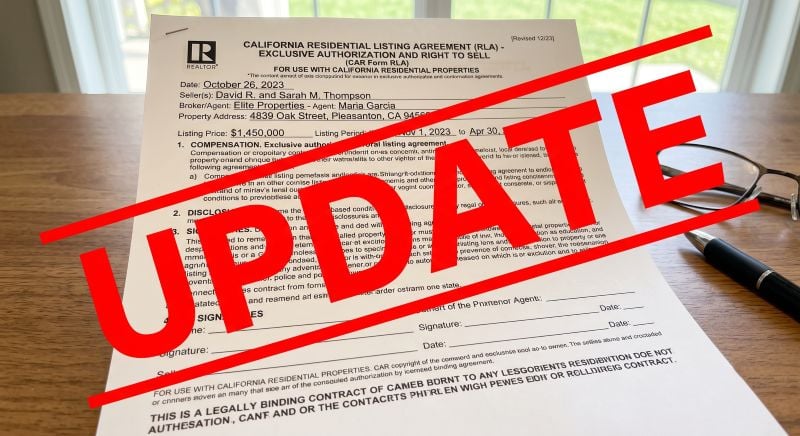
RLA Revised 6/26: What Changed and What's New
The June 2026 California Association of Realtors® (C.A.R.) residential listing agreement (RLA) is not a refresh. It is a rewrite of how compensation works, how unrepresented buyers get handled, and what sellers need to consent to before the first showing.
Compensation Lives in Two Buckets Now
The old RLA had a single line for total commission, and everybody understood it the same way. That line is gone. Paragraph 2C (1) now covers only what the seller pays the listing broker.
Paragraph 2C (2) is new and covers additional compensation when the buyer has no agent. The CDAR summary confirms the RLA was revised to add "clarification on compensation and advise on Buyer Non-Agency". If you are not using the new paragraph 2C (2) correctly, you are leaving money on the table or creating a compliance problem. Pick one.
Unrepresented Buyers Finally Have a Protocol
Every agent has had this conversation. A buyer walks into an open house, loves the place, and wants to write an offer. No agent. No representation. The old form did not tell you what to do next.
The new one does. Paragraph 2C (2) directs the broker to provide a Buyer Non-Agency Agreement (C.A.R. Form BNA) when the buyer is not represented [RLA 6/26, Para 2C (2)]. The CDAR summary explicitly flags this as a revision focus. In dual agency situations, the broker must now have a separate written agreement with the buyer establishing compensation for the buyer's side. You cannot just add a line and call it done.
Seller Concessions Are Defined for the First Time
Paragraph 10 is entirely new, and it fixes a problem I have watched confuse sellers and agents alike. Concessions are monetary payments toward the buyer's costs, including escrow, title, lender fees, repairs, inspections, and buyer broker compensation [RLA 6/26, Para 10].
The paragraph states flatly that concessions listed in the MLS are not promises to pay. They signal willingness to consider offers. Only the accepted purchase agreement makes them binding. If you have been treating MLS concession fields as binding offers, stop.
Digitally Altered Images Have Their Own Rule
Paragraph 12C is new, and it comes from California Business and Professions Code § 10140.8, which took effect January 1, 2026. If you use a virtually staged or AI-enhanced image, you must include a statement that the image is altered and provide a link or QR code to the original. Skip this, and you are in violation whether or not you meant to mislead anybody—no more housefishing allowed.
Buyer Letters Get a Warning Label
Paragraph 7C is new and reflects the reality that buyer supplemental (love letters) offer letters often reveal protected class information. Sellers can now opt out of receiving them entirely or choose to receive them with the understanding that relying on them is against the broker's advice [RLA 6/26, Para 7C].
If a seller picks option B and later gets sued for discrimination, the listing agreement already documents that they were warned.
The PRBS-S Form Is Brand New
The Disclosure and Seller Consent to Possible Representation of More Than One Seller, and Dual Agency in a Transaction (C.A.R. Form PRBS-S) was created in June 2026. It replaces whatever ad hoc disclosure you were using before. It covers both multiple-seller representation and dual agency in a single form with its own signature block [C.A.R. Form PRBS-S, Revised 6/26, Para 2].
What Stayed
The compensation triggers in 4D, the holdover period in 4D (2), the mediation requirement in 19A, and the indemnification clause in 7F all survived [RLA 6/26, Paras 4, 7, 19]. The rest of the form got pulled into the post-settlement world whether you were ready or not.
For Now,
My advice is to sit down with your compliance officer at your brokerage to go over the changes. We’re still feeling the consequences of the NAR settlement, and it’s best to stay vigilant.