Who Will MLS 5.0 Serve?
MLS 5.0 will serve the customer of today and be ready for the customer of tomorrow. That customer is the REALTOR® and their customer, the buyers and sellers of real estate. According to NAR, Gen X and Gen Y made up 78.8% of all first time home purchases in 2007. This is a significant milestone. While there is a variety of information and definition about the different generations, one thing for certain is that there are truly generational differences based on the times in which people live, the seminal events in their lives, and the world conditions they experience during their lifetime. MLS has always been a Broker to Broker (Business to Business) Network. It was not created as a central platform to facilitate marketing efforts. Marketing today needs to take into consideration generational destinations, modes of communication, and targeted marketing messages. At who is this message targeted?
Understanding and Adapting to Generational Differences
From Wikipedia:
Generation X – Baby busters - 48 Million
- Original Latch Key Kids
- Independent
- Skeptics
- Techno literate
- MTV generation
- Inception of the Internet
Generation Y - Echo Boom - 80 Million
- Generation Me
- Confident
- Collaborative
- “Bathed in Bits”
In their book, Connecting to the Net Generation, Reynol Junco and Jeanna Mastrodicasa found that in a survey of 7,705 college students in the US:
- 97% own a computer
- 94% own a cell phone
- 76% use Instant Messaging and social networking sites.
- 15% of IM users are logged on 24 hours a day/7 days a week
- 34% use websites as their primary source of news
- 28% author a blog and 44% read blogs
- 97% have downloaded music and other media using peer-to-peer file sharing
- 49% regularly download music and other media using peer-to-peer file sharing
- 75% of college students have a Facebook account
- 60% own some type of portable music and/or video device such as an iPod.
They represent Tomorrow’s REALTOR® and Tomorrow’s Home Owner. MLS 5.0 is built to fulfill the expectations of the REALTOR® and consumer of today as well as the REALTOR® and consumer of tomorrow.
Being at the Center of the Conversation
It is no longer sufficient to be at the "center of the transaction." If a REALTOR® waits until the transaction, it is too late. To be at the center of the transaction, the REALTOR® must be at the "center of the conversation" about real property and participate with consumers far in advance of the actual listing or sale. This of course has always been the case, and is now, more and more, taking place through visibility and participation on the Internet, through social networking and social influence marketing. MLS 5.0 on its public facing side will give consumers and REALTORS® the ability to engage and discuss, bringing them together to fulfill the long stated promise of listings on the Internet, to bring the REALTOR® and the consumer together. Generational aspects of communication and information access beyond current inventories of properties for sale are important considerations as the sale period of a property is merely a snapshot in the life of a property and just a part of a continuous historical record that will now be available, easy to find in a parcel based MLS, through parcel numbers, addresses, or maybe even distinct URLs. Web 2.0 concepts and philosophies, sharing and collaborating, must be built into the MLS structure and mindset, and released for use as the political and territorial constraints allow, and as consumers demand.
Enabling Innovation
MLS 5.0 envisions future vendors developing valuable real estate applications without being required to source the data and develop complex aggregation and data interpretation algorithms. Through the use of Open APIs that provide access to listing data, support existing authentication, and facilitate authorization, applications that leverage existing data can be built very cost-effectively leading to a richer ecosystem of features that will benefit real estate professionals.
Example (provided by Zach Scott, CTO Point2 Technologies):
Creating an application for the iPhone and iPod Touch
All PC-based platforms will support any browser resolution and will be designed to be highly usable at any resolution above 1024x768. Point2 web logs indicate that fewer than 10% of users/visitors have resolutions below 1024x768. See http://www.w3schools.com/browsers/browsers_display.asp for more detailed web statistics and trends.
Specific add-on modules will only be used to enhance the product and will not be required. Add-on modules such as Flash, ActiveX, or Java could be used to enhance the end-user experience for image uploading and searching, for example.
There are no specific client-side requirements beyond having a supported web-browser, an internet connection and any CPU, memory or hard drive requirements recommended by the browser’s vendor.
Ultimately to realize the MLS 5.0 vision, we will provide support for our Open APIs to enable other vendors to offer applications that leverage the listing information. Although the APIs are open, MLS 5.0 will remain in control of authorization and policy enforcement to protect access to sensitive features and data.
The APIs will be designed to fit the needs of MLS 5.0 and will likely consist of numerous REST-based and/or SOAP-based interfaces protected by SSL and other standards-based authentication and authorization mechanisms. In addition to this, client SDKs may be provided in multiple popular languages, such as PHP, Python, Java, .NET, and Ruby.
It is envisioned that numerous MLS vendors will adapt their products to work directly with MLS 5.0 via these open APIs in order to provide REALTORS® with a full featured and familiar front-end. Imagine being able to choose from a multitude of CMAs, or create your own application specific to your business. All the data can be stored in one database, and based on permissions, accessed and solutions and applications developed. In summary, the future will be a more open environment where brokers and agents can select their “Software of Choice” from numerous providers.
Single Point of Entry and Content Distribution (Syndication) - "Distribution Trumps Destination"
No one goes to just one web site; most people go to many and everyone has their favorite. It is in the best interest of the homeowner to have their listing appear on the Internet on multiple web sites, from Google, to Yahoo, to Trulia, to Craigslist, and more. It is a lot of work for agents to enter the data multiple times. This process should be no more difficult than entering the data once and having it distributed to the media outlets of your choice, as determined by the brokers. That is why the MLS of the future will include a syndication engine with comprehensive reporting features to enhance web advertising initiatives by brokers and agents.
The traditional MLS was not created to market to the world outside of its subscribers and participants. The MLS of the future will bring a marketing service and benefit to the industry by being the single point of entry for listing data and then, based upon the election of the broker, distribute that information to web portals, newspapers, even radio and television, handheld devices and applications. The MLS will go from being a tool for the sharing of inventory to being THE primary marketing control point for brokers and agents, and providing marketing analytics back to listing agents that will help with advertising decisions as more advertising dollars continue to be spent online in the future. The below is an old graphic but the evidence is clear, an inordinate amount of media spend is still taking place offline. Online advertising can be targeted and more effective than old media. As brokers begin to spend more money online, how will they decide where to spend their dollars for greatest effect? Tracking and analytical tools coupled with predictive marketing tools.
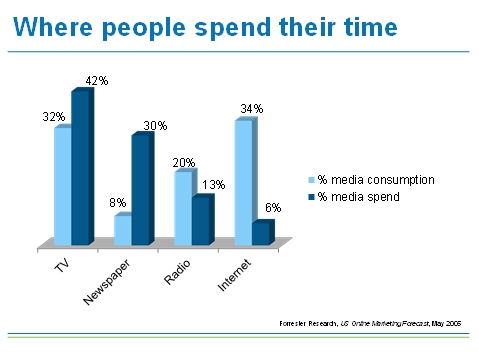
Advertising clout and reduction in advertising costs may be realized through buying power and packaging of purchases.
Lead Generation – through listing syndication, all leads can and should be directed to the listing agent, at no charge. Listings are marketing assets and the leads created from the work expended to acquire the listing should go directly to the listing agent.
Referral Network
A referral network where REALTORS® gain exposure and "social capital" based on their contribution to and participation in various online communities will be part of MLS 5.0. No third party referral fee - this is a benefit of participating. Gen X and Gen Y have been raised participating online, as evidenced by the explosion of Facebook and MySpace. A connection between the MLS and these social networking sites will be a feature of the MLS of the future.
Agent Rating System
Should this be provided through the MLS or through a third party?
Some of the information that would be useful in the creation of an agent rating system is readily available through the MLS (and the association). Information such as:
- How long agent has been a member of the MLS
- How many transactions completed since joining
- Buyer sides
- Seller sides
- Volume based on sales price
- Average sale price
- Median sales price
- Consumer complaints
- Ethics complaints
This is a political hot potato. Even if the MLS does not provide a system, it could facilitate a third party in the delivery of this service to the public.
Many agents and brokers hate this idea, but consider, if you could find out before you went to a doctor or a lawyer, where they went to college, where they went to law school, where they graduated in their class, how long they have been practicing, if they have any complaints against them…would you, as a consumer, find this information valuable?
If you answered yes, why would it not hold true for the real estate industry?
Neighborhood data
Buyers typically choose a neighborhood first, then a home. Rarely do they define the neighborhood they are interested in by its zip code (which is how many MLS searches are done), and good geographical definitions of neighborhoods are not readily accessible and often have what can be referred to as “fuzzy boundaries’.” By employing the “wisdom of the crowds” and online communities, neighborhoods will be better defined to the benefit of consumers and REALTORS®.
No one can contribute and help build neighborhood data like REALTORS®. The MLS of the future will have the most comprehensive and accurate neighborhood information available on the Internet. A Facebook application, currently deployed by Point2, will assist in this effort.
Sold Data
There are political hurdles to overcome, but one of the biggest lures of eyeballs to web sites is the promise of sold data. Consumers want the information and have proven that they will settle for anything, even inaccurate data. The owners of the most accurate historical sold data are the MLSs. There is no aggregated sold data in existence that is as good as the sold data contained within our MLSs. Making certain aspects of that data available to consumers, with the statement to always consult a REALTOR® when attempting to determine value, would be valuable in the battle for the consumer's attention on the Web, and valuable to REALTORS® as well. It is interesting to note that sold data is available on the web, yet one of the places you will not find it is on a REALTORS® web site (with some exceptions). All brokers and agents want more traffic to their sites, and they do not want to buy leads…and they have the asset that will help them rule the online world of real estate, and they don’t use that asset for fear of losing control.
Strong Authentication (Two Factor Authentication)
Various processes and methods of authentication may be provided as determined by the local/regional/state MLS when appropriate and timely. While it is generally felt that more security will prevent or at least minimize revenue erosion, it could also serve to position the MLS as the location for the initial sign in of participants and subscribers. As MLSs create trusted relationships or federations with other organizations, the strongest required authentication partner would likely be the controlling federation and identity partner.
SSO - Single Sign-On
Convenience and the ability to sign into other secure web locations after first signing into the MLS with the ease of a click.
- From MLS to other Local MLS
- From MLS to Local Association
- From MLS to State Association
- From MLS to National Association (REALTOR.org)
- From MLS to transaction related sites (Winforms/Relay)
- From MLS to third-party web marketing platforms and agent and broker web sites
- From MLS to third-party CRM (customer relationship management) solutions
- From MLS to third-party social networking sites (such as currently being done from Rapattoni MLSs to RealTown)
- From MLS to non-real estate related sites: Facebook, MySpace, LinkedIn, gmail, etc.
Online Communities
Consumers will assemble around a website with accurate sold data and property listing data. Social networking tools such as blogs, groups, bulletin boards, and other community tools, should be readily available as this is where the “online conversation” will take place. Communities can be open and they can be private, depending on the desire of the “community organizers.” Virtual prospecting may replace “face to face” prospecting in the next generation and beyond and MLS 5.0 on its public facing side will fulfill the vision of bringing the consumer and the REALTOR® together on the Internet.
Local, Regional, State, or National MLS
Real estate is local, but technology today will allow for great economies of scale, lower prices for a better MLS tool, user-defined experience and more. In the past, each MLS, or locale had their own idiosyncrasies, definitions, terms, all “essential” to that particular local MLS. Today, with so much information available beyond the MLS, are all of those different fields still necessary, in light of the benefit that can be derived from creating standards…not technology standards, but standard terms?
Is there a technology solution that would allow for the mapping of data so that every local MLS can retain all of their information fields? There is, a data dictionary of sorts, similar in concept to what was referred to as DXM (Data Exchange Method) during the REALTORS® Information Network Project (RIN) back in the mid 1990s, but it is not a necessarily easy task and this solution would likely take longer.
There is the fear for some that someone with access to listing information in their area will invade their territory and carpetbag some business. In light of this fear, some want to attempt to keep the listing information proprietary to their respective MLS participants and subscribers. The next generation of home buyers, sellers and REALTORS® won’t stand for it, they will insist on more transparency and freer flow of the listing and marketing information.
The real benefit in boundary-less access to information is in the ability to provide information to one’s relocating client, not the ability to sell a home down in San Diego to a buyer from Los Angeles. A Los Angeles broker would be able to provide information to their customer and refer them, better armed with knowledge about the San Diego market, to a San Diego broker. Great advances are being made to regionalize or share MLS data in mega markets in California and also in other areas of the country. These efforts are steps in the right direction.
Summary
When do we start? Some MLSs already have begun, so the answer is yesterday. The successful creation of MLS 5.0 will require vision, leadership, and courage. The technology is not the challenge -- people, organizations, their habits and models of the world are the challenge. The words of Peter Ducker, father of modern management, have never been more applicable: “Every organization has to be ready to abandon everything it does, to reinvent itself.”
There will be controversy and debate between knowledgeable and well-intentioned people. Association and MLS leaders, staff and volunteers, brokers and agents must collaborate to create the MLS of the future, otherwise their MLS of the present will become a relic of a bygone era. Our industry is going through nothing less than a "Paradigm Shift" driven by technology and generational forces. As stated by Joel Barker, author of Future Edge, "when a paradigm shifts, everything goes back to zero". MLSs and Associations, large and small, rich and poor, must assist brokers in creating compelling arguments for membership and compelling arguments for consumers to use the services of real estate professionals. It is said of Gen X-ers that being of the “latch-key kid” generation; they have always done everything for themselves, and feel that they can continue to do things by themselves. Give them some Starbucks and access to Google and they can fly the space shuttle. Their attitude might be “Why would I need help finding and buying a house?”
MLS and the industry today can become the creators of the future instead of the victims of circumstance. Creating a future by design instead of a future by default requires the ability to deal with massive and increasing amounts of information in a rapidly-changing and participatory environment. The answer is not just an MLS, but the MLS of the future, MLS 5.0, which incorporates the consumer, and makes the REALTOR® a participant in the conversation, not just a cog in the transaction.
What is the alternative?
If we don’t do it, the list of alternatives is growing: Craigslist, Google, and others, some not yet created, all in the spirit and built with the concepts, philosophies, and building blocks of Web 2.0 and putting property information in context for the consumer. For real estate professionals, now is the time to create your compelling argument for what you do and what you charge. The same holds true for MLS.
Famous Last Words
“We can never be replaced. This is a people business and there is always going to be a need for a real estate professional in the transaction.”
Today, there are artificial intelligence software packages that know more about the transaction process than many agents. Inventories are easily accessible online. Homes are easily and inexpensively advertised online by anyone with very little technology expertise required. Complacency about one’s value in the home buying and selling process could prove disastrous.
“During the 1970s and early 1980s, technological upheavals (appearance of the quartz technology) and the difficult economic situation resulted in a reduction in the size of the industry: the number of employees fell from some 90,000 in 1970 to a little over 30,000 in 1984.” Federation of the Swiss Watch Industry FH
The paradigm shift that eviscerated the Swiss Watch Making industry was the quartz crystal, invented by the Swiss, not protected, and used by competitors to make their highly skilled craft obsolete.
Transaction of the Future
Marketing Homes
Party A wants to sell and advertises her home on Craigslist
Party B wants to buy Party A’s home, Party A does not want Party B’s home, so the two Parties now work through their channels to sell Party B’s home.
Party C is found and wants to purchase Party B’s home, but needs to sell his home first. Parties A, B, and C all now work their channels to find a buyer for Party C’s home.
Party D is found, wants to purchase Party C’s home, and Party A (remember Party A?) wants to purchase Party D’s home.
Consumers Bundle the Entire Deal
Contracts are created (maybe with the help of an attorney, or artificial intelligence software.
Parties offer through a bidding process on e-Bay the entire package to one broker. Lowest bidder with most experience wins the bid.
Consumers save tens of thousands of dollars.
In Conclusion
There is a lot of information contained in this paper, and yet, it is but an annotated outline of what must be done to take advantage of and build upon the strengths of MLS and of the real estate brokerage business. MLSs must use their strengths today to secure their position in the future.
MLS is really an amazing creation if you think about it…A collection of competitors, in a highly competitive, commission-only business, sharing inventory and sharing compensation. The result is a more effective market for real estate practitioners and consumers. Over the years, MLS has changed and it continues to have the most accurate property data available anywhere, constantly updated and kept accurate by an army of agents whose only monetary compensation comes when the transaction “closes.” Today, agents and homeowners themselves are advertising their properties on Craigslist, Google, Yahoo!, and many other sites. All of these sites would love property information available from MLSs because it is unquestionably the highest quality and most accurate of any existing source.
What if the self-policing aspects of a real time Web really began working on Craigslist, Google, or any other online destination site? What if every seller “intuitively” knew that the place to advertise their home to consumers and to agents was on Craigslist (or Facebook or any other growing number of web site destinations)? What if they knew how to post it on Craigslist themselves (and you, the real estate professional did not know how)? In short, what if the impossible becomes possible? If Google became the source of all available properties for sale, nationwide, how might that impact the business of MLS? If as a REALTOR® you could find the complete inventory of property for sale, for free, why would you pay a fee to belong to MLS?
You may think it will take a long time for Google (Yahoo! Etc) to become known as the place for sellers to list property and consumers to find property, and you may be correct.But recall, how many people knew of Google just 10 short years ago and how many know of it today? How many people knew of Craigslist 10 years ago and how many know of it today? In a short span of time, unknown web sites have become household words. The world of MLS as we know it is approaching a cliff, and many riding the MLS train, do not see the cliff as it gets closer with each passing day.
So here is the point. Most of us don’t relish change, but at the same time we have experienced that in life, many things fail to remain as they have always been, so how is MLS any different? To secure its place in the future, MLS must redefine itself from a purely Business to Business (B2B) network and look to becoming a marketing facilitator for its participants and subscribers. It needs to take advantage of its assets and shift its paradigm from information about what is for sale, to information on all property whether for sale or not. From this perspective, brokers and agents can continue to effectively differentiate themselves from the competition, manage information more efficiently, provide more service to their customers, and evolve to be the “trusted and authoritative source” they want the world to believe that they are.
Is the creation of MLS 5.0 a major project? It is. It will require conversation and analysis by all who are considered as stakeholders…but how do you eat an elephant? You have heard it for years: “one bite (byte) at a time.”
A PDF of today’s article is available; to receive a copy, please contact Saul Klein