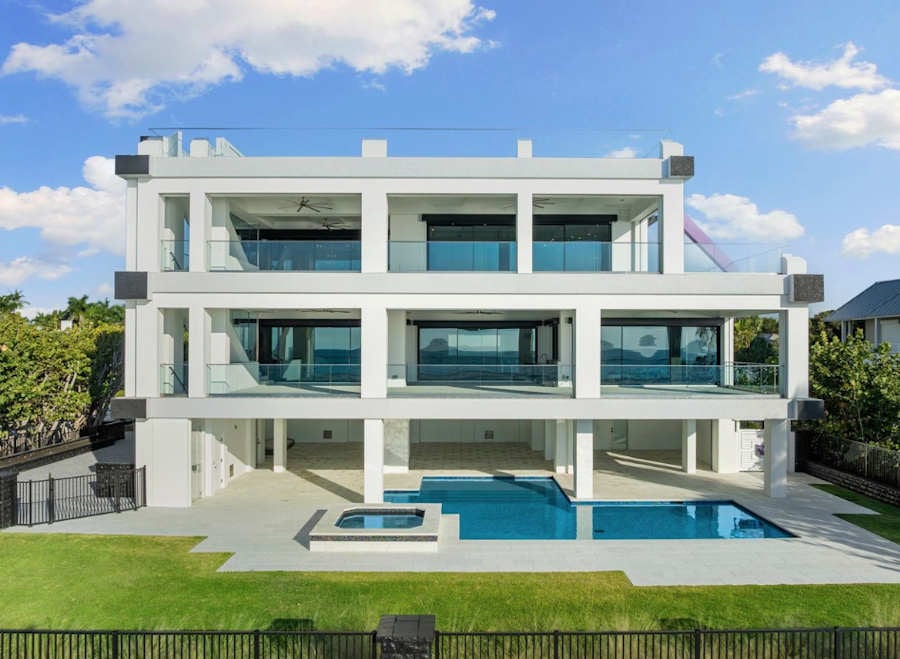
A few weeks ago I wrote a column entitled, "Why New Home Prices Are Too High ," which argued that "the most obvious reason for steeper home prices and less affordability is that we simply have bigger houses."
It seemed fairly unmistakable to me that if typical new homes are increasing in size, and if costs per square foot are not steady or declining, then one sure reason for higher new home prices is that homes are simply bigger.
And, in fact, homes are getting bigger. According to the Census Bureau , the average home measured 1,660 square feet in 1973 and 2,434 in 2005.
"If you super-size a home by 47 percent," I said, "then even if construction expenses remained constant it's not hard to see why today's housing dreadnoughts cost more than homes in previous years."
What's remarkable about square foot numbers, of course, is that while houses are swelling, households are shrinking. In 1978 the average household had 2.81 people, according to the Census Bureau, while in 2003 that same household typically had 2.57 residents.
I surely did not suggest that growing home size was the ONLY cause of declining affordability. As I wrote:
"This is not to say that minimum lot and home sizes add anything to the cause of affordable housing, or to suggest that rising costs for building permits, impact fees and transfer taxes are helpful. But c'mon, homes on steroids can't be overlooked -- homes which surely yield bigger builder profits per unit than smaller homes."
The National Association of Home Builders offers a different view. In an e-mail, David Crowe, the association's senior staff vice president for regulatory & housing policy, says, "NAHB disagrees with the premise that new homes are less affordable simply because they are bigger."
Fair enough. Mr. Crowe continues:
Take a look at the increase in existing home prices over time compared to new home prices:
The 1978 median priced new home was $55,700. In 2005, that home was worth $242,000 using the OFHEO purchase price index of housing prices. That index compares the sales prices of the same home across time, so there is no size or quality bias. The median sales price of a new home built in 2005 was $240,900. As you can see, the prices of both new and existing homes has risen without regard to home size.
No, actually, I don't see anything of the sort.
If the median new home was priced at $55,700 in 1978, then calculations from the Bureau of Labor Statistics say that corrected for inflation that same home would be priced at $166,844 in 2005 dollars. It wasn't. It was priced at $242,000 -- a difference of $75,156.
If I was a home builder I would be elated that the value of new homes is rising faster than the rate of inflation. That suggests new home buying in general has created additional purchasing power -- real wealth for owners -- and that's a really good reason to buy a new home.
If it's true that the prices of both new and existing homes have risen without regard to home size, that would mean there is no value to the additional square footage we see in today's typical home or that costs per square foot have declined. But if costs per square foot are falling, would not new homes be more affordable?
As NAHB said in a June news release , "Rising mortgage rates, deepening affordability issues and the retreat of investors/speculators from the marketplace have prompted single-family home builders to further adjust their perspectives on the new-home market, according to the National Association of Home Builders/Wells Fargo Housing Market Index (HMI)."
"The HMI," said NAHB, "declined four points from an upwardly revised reading in the previous month to hit 42 for the latest report, its lowest mark since April 1995."
It makes no sense to believe that higher new home costs and reduced affordability are not a by-product of additional interior volume. While volume is not the only cost to consider, it's surely a cost that cannot be ignored.
If it is true that older homes are essentially priced the same as today's new and larger homes, it does not mean that additional new home square footage is somehow free or irrelevant. Rather, such numbers merely demonstrate that people are willing to pay more per square foot for older homes located in established, close-in, short-commute neighborhoods than they will pay for elephantine homes on the outer edge of metropolitan areas and down the street from cows and sheep.
If, as NAHB points out, new home affordability can be increased by holding down lumber costs and storm water management expenses, then why can't affordability be increased by building smaller homes? Is there a shortage of people willing to pay less?
For more articles by Peter G. Miller, please press here .