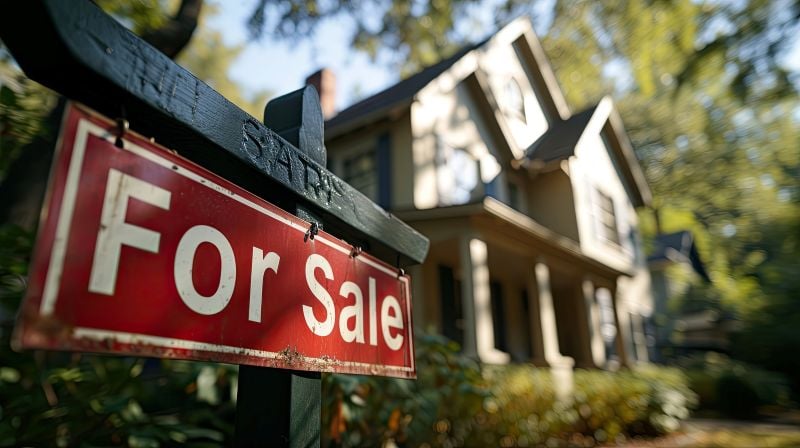
Is the market oversupplied with real estate agents?
One would think not, considering the increase in inventory in many regions -- 60 percent to almost 300 percent in some places.
Yet survey after survey has a shown that a very small number of agents and brokers handle a very large percentage of the residential business, which means that a lot of Realtors -- probably the ones newest to the business -- are being left in the cold.
I remember a time somewhat like this one, except it was being called a real estate "bust" rather than a return to a "normal" market.
We had just put our first house on the market because we had outgrown it, and the private school to which we wanted to send our then-only son would have required expensive transportation if we didn't move closer.
My wife and I knew well that our neighborhood was on the fringe, there were safety issues, the number of houses we were competing against was staggering, fixed interest rates were exceeding 10 percent, but we had no other choice.
The first agent had been the business less than a year, and only knew how to sell in a up market. The house sat on the market with no offers for three months; the agent couldn't be bothered to show up for scheduled open houses. Each time we called to ask for feedback or suggestions, she would tell us not to worry because she was sure the house would sell.
The next agent also was a newcomer who, after an enthusiastic presentation and many promises, fell victim to personal problems -- a messy divorce -- and left us hanging for another month.
Fortunately, a veteran agent (age 80 with 40 years in the business) took over from her colleague and was able to sell the house for the asking price in a few days.
When the membership of the National Association of Realtors began to grow in 2001, many of the newcomers were attracted by the mistaken belief that the average agent was earning hundreds of thousands of dollars a year by doing virtually nothing.
They'd see all the sold signs, multiply the number by a 6 percent commission, and think it would be easy to make a living. What they didn't realize was that they should divide that number by 4, because that is about what they will earn after expenses, if they are lucky.
Net commission is more like 1.5 percent.
Remember that the housing industry has been the linchpin of the economy since the turn of the century. The flow of people in need of gainful employment into real estate was more like a tidal wave, and it didn't bother anyone that, in the words of one real estate economist, just because half of the agents in the business can't financially justify being in real estate doesn't seem to matter.
For all but 6 percent of today's agents, real estate is a second career. I've spent the last several years attending gatherings of real estate agents during which I'd hear someone say he or she is a real estate agent, "But I used to be a teacher." That person seems to be apologizing for being in real estate because it is incongruous with his or her self-image.
Mentioning present and former careers in the same breath seems to say that these newcomers are just killing time until a real job comes along.
For those few for whom selling houses has been their only career, this revolving-door attitude robs real estate of professionalism. A lot of people in other fields believe they can moonlight as real estate agents to supplement their incomes. But it has to be more than a part-time occupation, especially when you deal with first-time buyers who need face-to-face contact and have you accessible all the time.
Having people going in and out of that revolving door doesn't result in professionalism by any stretch of the imagination.
That's not to say that the industry hasn't benefited from the influx.
Corporate mergers have brought some top-notch professionals into the business that gave it a nice mix of backgrounds. More immigrants and minorities also have been attracted to the ranks, and since these two groups are the source of a growing number of buyers, it makes perfect sense.
Still, there is only so much business to be had. A decline in business in beach towns has forced many agents to wait on tables at restaurants this summer to supplement their incomes, for example.
How quickly the market will heat back up is an unknown. But the experts are saying it may not happen soon enough to prevent a shakeout of the industry many of them have been predicting for several years.