This article answers the question: How can marketers use AI to earn customer attention before demand fully forms?
Answer: According to Daniel Burrus, AI is changing the future of marketing by making content abundant while making timely customer attention more scarce and valuable. In an AI-driven marketplace, the brands that win will not be the ones that create the most content, but the ones that use Hard Trends, predictive content, personalization, micro-moments, and trusted, easy-to-verify messaging to become relevant before the customer starts looking. By applying an Anticipatory Mindset, marketers can stop chasing attention after it moves and start designing useful, timely experiences that earn attention in the moment before demand forms.
What Is the New Scarcity in an AI-Driven Marketplace?

I have always taught that when something becomes abundant, its value changes. AI is making content abundant. Generative tools can create blogs, ads, videos, images, emails, and social posts at a speed no human team could match.
Grand View Research estimates the generative AI content creation market at $14.8 billion in 2024, with projected growth to $80.12 billion by 2030.
That growth is not a surprise. It is a Hard Trend. Content supply will keep expanding. Human attention will not.
The scarce asset is no longer the message. The scarce asset is the moment of relevance.
Why Should Marketers Stop Chasing Attention?

Traditional marketing often worked like a chase. Create the campaign. Push the message. Measure the response. Adjust.
That model is too slow for a world where AI, search, social feeds, and recommendation engines shape choices before a person visits your website.
The better question is not, “How do we get more impressions?” The better question is, “How do we become relevant before the customer starts looking?”
This is where an Anticipatory Mindset changes everything. I define Anticipatory marketing as using Hard Trends to identify customer needs before they become visible demand.
When you arrive early with relevance, you do not interrupt attention. You earn it.
How Are Customer Decisions Being Compressed?

Customers no longer move through long, predictable buying journeys. Many decisions now happen in compressed micro-moments.
Google describes micro-moments as intent-driven points when people turn to a device to learn, do, discover, watch, or buy. Those moments are becoming smaller and more decisive.
A buyer may ask an AI assistant for a recommendation before searching. A shopper may compare prices while standing in a store aisle. A business leader may read an AI-generated summary instead of clicking through ten links.
If your brand is not present in that moment, you are invisible.
Speed matters, but timing matters more.
What Makes Personalization the New Minimum Standard?

Personalization was once impressive. Now it is expected.
McKinsey found that 71% of consumers expect personalized interactions, and 76% get frustrated when they do not receive them. Faster-growing companies also generate 40% more revenue from personalization than slower-growing peers.
That is not a passing preference. It is a behavioral Hard Trend.
Customers expect brands to understand where they are, what they have already done, and what they need next. But there is a fine line. Poor personalization feels invasive. Smart personalization feels helpful.
Useful relevance wins because it reduces friction. Creativity still matters. But relevance decides whether creativity gets seen.
What Should Predictive Content Actually Do?

Predictive content is not simply automated content. It is content that moves ahead of demand.
It reads behavior, identifies patterns, and delivers the next useful message before the customer has to ask. That requires marketers to think less like campaign managers and more like system designers.
A campaign starts and stops. A predictive system learns continuously.
Strong predictive systems should:
-
Detect early signals of intent
-
Adjust messages and offers in real time
-
Remove friction before it becomes frustration
-
Present proof at the moment trust is needed
This is Anticipatory strategy applied to marketing. You use what you can know in advance to create value sooner.
Why Will AI Decide What Customers See First?
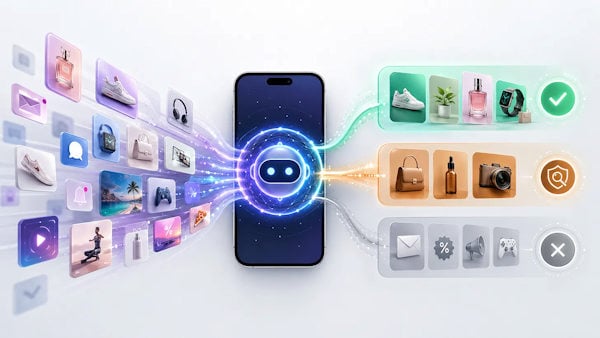
Your next audience may not be a human first. It may be an AI system.
Gartner predicts traditional search engine volume will drop 25% by 2026 as AI chatbots and virtual agents gain share. Google also reported that AI Overviews reached 1.5 billion monthly users across 200 countries and territories by I/O 2025.
That changes how brands must communicate.
AI systems reward clarity, structure, proof, and trust. If your content is vague, outdated, difficult to verify, or buried in marketing language, it may never reach the customer.
Brands must now write for people and for the AI systems that guide people.
Why Is More Content Often the Wrong Answer?
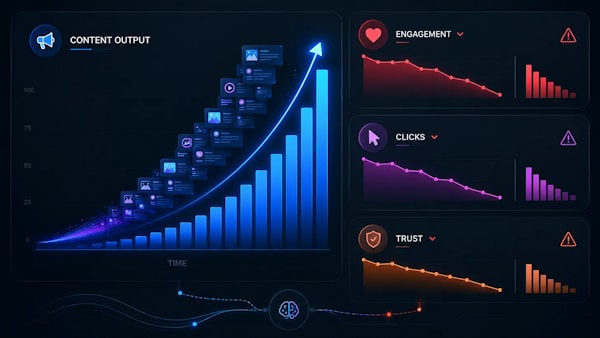
When engagement declines, many teams produce more. More posts. More emails. More campaigns. More videos.
That response usually makes the problem worse.
Adobe reports that two-thirds of brands are not giving customers the right content at the right moment, while 78% of consumers expect a seamless experience at every touchpoint.
The problem is not always content volume. The problem is timing, trust, and relevance.
More content without anticipation becomes noise. Static content falls behind customer behavior. Generic messaging gets filtered out by people and algorithms.
The answer is not to publish more often. The answer is to become useful earlier.
What Will Define Marketing Advantage by 2030?

By 2030, the advantage will shift from content creation to content selection, timing, and trust.
Deloitte’s 2026 Digital Media Trends report points toward always-on engagement through owned environments, social content, shopping, and exclusive experiences. That signals a larger shift. Brands will need more direct access to customers, not just rented access through platforms.
The Hard Trends are clear:
-
AI curation will expand
-
Personalization will deepen
-
Customer patience will shrink
-
Trust will determine access
The Soft Trend is your response. You can keep reacting after attention moves, or you can build systems that anticipate where attention is going next.
How Can You Build Relevance Before Demand Forms?

Start with certainty.
In my work, I teach leaders to separate Hard Trends from Soft Trends. Hard Trends are future facts that will happen. Soft Trends are assumptions you can influence.
For marketers, the Hard Trends are already visible. AI-generated content will increase. AI filters will shape visibility. Customers will expect deeper relevance. Micro-moments will compress decisions.
Your opportunity is to act before these trends force your hand.
Ask the following questions:
-
What customer need can we know in advance?
-
What friction can we remove early?
-
What proof will both humans and AI trust?
-
What content should appear before the search begins?
The future belongs to marketers who design for the moment before the customer asks.
Are You Ready to Anticipate the Next Moment of Attention?

The attention economy will not reward the loudest brand. It will reward the most relevant brand at the earliest meaningful moment.
That does not happen by accident. It happens when leaders build the ability to see customer needs earlier, act with greater certainty, and create relevance before the market demands it.
This is where my Anticipatory principles become a business advantage. Through future-focused keynotes, advisory services, strategic consulting, and the Anticipatory Organization® Learning System, I help leaders identify Hard Trends, solve problems before they grow, and uncover opportunities before competitors see them. www.burrus.com
Stop chasing attention after it moves. Start anticipating where it will go next.