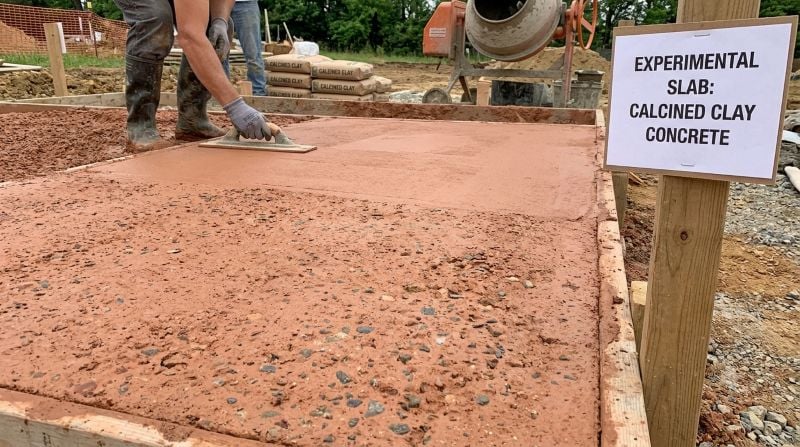
Calcined clay concrete uses heat-treated clay alongside limestone as part of the cementitious binder to reduce reliance on Portland cement. Supported by UK building standards, this multi-component approach lowers embodied carbon while maintaining the durability and aesthetic control required for bespoke commercial concrete finishes.
For decades, the architectural community relied on ground granulated blast-furnace slag (GGBS) and fly ash to lower the embodied carbon of cast concrete. Those supplementary cementitious materials (SCMs) served the industry well. However, supply constraints and evolving sustainability targets now demand a broader vocabulary of materials.
Portland cement remains the primary carbon hotspot within any concrete mix. Reducing its volume is an absolute necessity for the built environment. Today, forward-thinking specifiers require alternative binder strategies that deliver environmental benefits without compromising the pristine visual quality of exposed architectural elements.
Calcined clay represents the next wave of binder innovation. By understanding how this material interacts with UK specifications, production timelines, and aesthetic finishes, your design team can implement robust low-carbon concrete strategies. This guide details the practical realities of specifying calcined clay concrete for high-end commercial interiors, public realm objects, and bespoke architectural features.
Why is low-carbon concrete moving beyond GGBS and fly ash?
The Concrete Centre notes that SCMs can be lower in embodied carbon than Portland cement, framing them as a critical part of the net-zero jigsaw. Historically, UK specifications leaned heavily on binary combinations of Portland cement and a single industrial byproduct like GGBS. As global industries decarbonise, the availability of these traditional materials is changing rapidly.
The publication of BS 8500:2023 modernised the UK specification landscape by supporting the use of multi-component cements. This standard empowers designers to utilise combinations of two or more SCMs. By expanding the permitted binder combinations, the industry reduces its reliance on scarce resources and opens the door for highly reactive alternatives like calcined clay.
What exactly is calcined clay concrete?
Calcined clay concrete utilises clay that has been thermally activated through heating to improve its reactivity as a cementitious material. When combined with Portland cement and limestone, it forms a highly effective lower-clinker binder.
The best-known formulation is LC3 (Limestone Calcined Clay Cement). According to the LC3 network, this specific blend reduces CO2 emissions by up to 40% compared to traditional Portland cement. LC3 achieves this impressive reduction by replacing a significant portion of the clinker with abundant low-grade clays and limestone. This scalability makes calcined clay a highly practical and sustainable low-carbon building material for the future.
Is calcined clay concrete commercially available in the UK?
Yes. Calcined clay concrete has moved out of the laboratory and onto active UK construction sites. Local material availability is a crucial factor for any valid sustainability claim, and the domestic production of calcined clay from sources like damaged waste bricks is steadily increasing.
A prominent example occurred in 2026 at the Brent Cross Town regeneration project. The contractor successfully poured a permanent suspended slab using calcined clay concrete, replacing 30% of the cement. This milestone achieved a 10% embodied carbon saving compared to equivalent mixes previously used on the exact same development. For architects who want lower-carbon concrete without risking their project on untested formulations, this commercial availability provides essential confidence.
How does calcined clay compare to GGBS and fly ash?
No single supplementary material is universally superior. Your specification must align with the specific performance, exposure, and aesthetic requirements of your commercial project.
Choose calcined clay if local availability and early strength development matter most to your timeline. Choose GGBS if you require a high degree of resistance to aggressive ground conditions and are prepared for longer curing times.
Here is how these materials influence your concrete specification:
-
- Calcined Clay: Offers excellent early strength and utilises abundant natural or waste clays. It often imparts a warmer, earthy undertone to the finished concrete.
- GGBS: A byproduct of steel manufacturing that significantly reduces early heat of hydration. It typically produces a lighter, almost off-white surface finish.
- Fly Ash: Sourced from coal power generation, providing excellent workability. It generally results in a darker, more grey aesthetic.
- Limestone Fines: Used in ternary multi-component mixes alongside other SCMs to further reduce Portland cement volume without degrading performance.
What questions should you ask your low-carbon concrete supplier?
Securing a heroic carbon claim on a specification sheet means little if the final surface fails to meet your visual standards. Decorative concrete requires rigorous aesthetic control. Use this checklist to interrogate your supplier early in the design phase:
-
- Compressive strength and curing: How does the specific calcined clay mix affect early-stage strength development and overall curing timelines?
- Aesthetic consistency: Can the supplier guarantee colour consistency across multiple large-format panels or bespoke cast objects?
- Surface finish: How does the binder alter the texture, porosity, and polishing potential of the concrete?
- Reinforcement compatibility: Is the mix suitable for the specified exposure class and the chosen reinforcement detailing?
- Environmental Product Declarations (EPDs): Can the manufacturer provide verified EPDs or project-specific embodied carbon calculations?
How does calcined clay affect concrete design and aesthetics?
Bespoke concrete is specified for its tactile and visual presence. Every ingredient in a mix alters the final appearance. Because calcined clay possesses distinct mineralogical properties, it frequently shifts the base tone of the concrete. Specifiers often observe a warmer, subtly terracotta-tinged hue compared to the cold greys of standard Portland cement.
If your project requires pristine colour matching for wall panels in retail shops, striking reception desks, or architectural seating in a public park, you must command control over these variables. We strongly advise commissioning physical sample boards and mock-ups before finalising the specification. A sample-led approval process ensures that the inherent natural variation of the lower-carbon binder aligns perfectly with your client's brand and the overarching design intent.
What other sustainable concrete options are available?
Bespoke concrete suppliers like MASS Concrete, Lazenby or Living Concrete are thinking beyond the traditional carbon-intensive nature of concrete.
Carbon-Cured Concrete (CO₂ Mineralization):
Traps captured CO₂ gas directly into the concrete mix during manufacturing. The gas turns into solid calcium carbonate inside the mix, permanently locking it away while actually increasing the material's compressive strength. It reduces the carbon footprint without requiring changes to structural designs.
Bio-Concrete (Self-Healing Concrete):
Embeds dormant limestone-producing bacteria (such as Bacillus) along with nutrients directly into the mix. When cracks inevitably appear and water seeps in, the bacteria awaken, precipitate limestone (CaCO₃), and autonomously fill the fissures.
Bio-concrete significantly extends the lifespan of structures and cuts maintenance costs.
Recycled Aggregate Concrete:
Replaces traditional quarried sand and gravel (virgin aggregates) with crushed, reclaimed construction and demolition waste. Recycled aggregate concrete by MASS Concrete promotes a circular economy by keeping inert building waste out of landfills.
How do architects verify low-carbon concrete claims?
Protect your project from lazy greenwashing by demanding transparent, verifiable data. A lower-carbon mix design does not automatically guarantee a sustainable outcome if the material requires excessive transport, generates high waste, or degrades prematurely in a commercial environment.
The Concrete Centre emphasises that designers can reduce embodied carbon through material substitution, structural efficiency, and lean design. Request verified EPDs from your manufacturing partners to substantiate any environmental claims. Evaluate the entire lifecycle of the bespoke element, factoring in durability, maintenance requirements, and eventual end-of-life recycling potential.
Which applications are best suited for calcined clay concrete?
As demonstrated by the Brent Cross Town project, calcined clay is structurally capable of meeting demanding commercial requirements. For interior designers and architectural specifiers, bespoke cast elements offer a brilliant, low-risk route to integrate this technology into a scheme.
Ideal applications include:
-
- Statement reception desks in corporate foyers.
- Bespoke servery counters and tea-points in high-traffic hospitality venues.
- Large-format decorative wall panels for premium retail environments.
- Durable architectural furniture and seating for public realm landscaping.
Frequently asked questions about calcined clay concrete
How much does calcined clay concrete cost compared to traditional mixes?
Prices vary based on project scale, specific mix requirements, and local material availability. Because the raw materials are highly abundant, calcined clay concrete is scaling as an affordable alternative, often achieving cost parity with traditional high-clinker mixes as supply chains mature.
Does calcined clay concrete require longer curing times?
Unlike GGBS, which often retards the curing process, calcined clay blends typically offer excellent early strength development. This characteristic helps contractors maintain efficient project timelines without the delays commonly associated with other high-replacement SCM mixes.
Can calcined clay concrete be polished or textured?
Yes. Calcined clay concrete responds beautifully to mechanical polishing, acid etching, and board-marked texturing. However, because the binder influences the matrix colour, specifiers should always review physical finish samples to ensure the processed surface meets their visual expectations.
Is calcined clay approved for use under current UK building standards?
Yes. The updated BS 8500:2023 standard fully supports the use of multi-component cements, including those incorporating natural and calcined pozzolanas. This regulatory framework gives specifiers the absolute confidence to utilise these lower-carbon binders in compliant commercial structures.