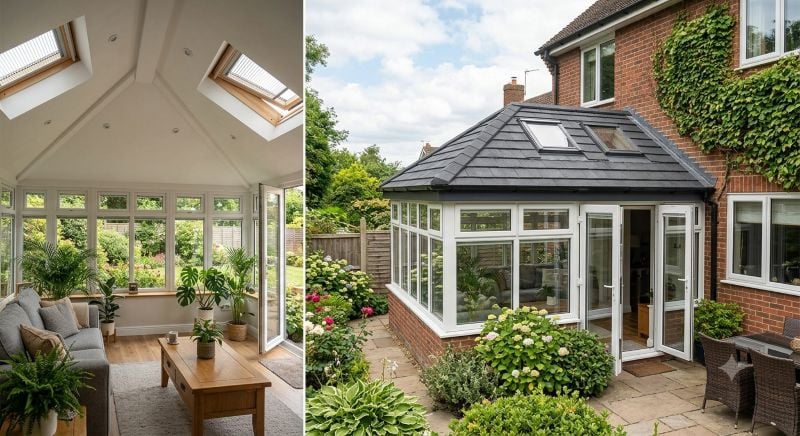
The best conservatory roof insulation system depends on your goal. Choose a full tiled or warm roof (Equinox, LEKA) for an extension-like transformation. Choose insulated panels (Cosy Panels, Stadur, ThermoPanels) for a faster, more affordable comfort upgrade. There is no single winner for every home.
If your conservatory is freezing in January, unbearable in July and deafening when it rains, you're not alone. Thousands of UK homeowners face the same problem: a room that's too uncomfortable to use for most of the year. The good news is that insulating the roof can fix all of this - and you have more options than you might expect.
The trouble starts when you begin researching. You'll quickly run into names like Eurocell, Equinox, LEKA, Cosy Panels, Stadur, ThermoPanels and RENOLIT. They sound like competing products, but they're not all the same kind of thing.
What's the difference between all these conservatory roof systems?
The confusion is understandable, because these names don't all describe the same category of product. Some are full roof replacements. Some are panel upgrades. A couple are simply the companies that make the materials:
|
Name |
Best described as |
Typical category |
|
Eurocell |
Supplier behind Equinox and other systems |
Brand/supplier |
|
Equinox |
Eurocell's tiled conservatory roof system |
Full tiled roof replacement |
|
LEKA |
Lightweight GRP-based warm roof system |
Full warm roof replacement |
|
Cosy Panels |
Insulated conservatory roof panel system |
Panel replacement/insulation upgrade |
|
Stadur |
Maker of insulated sandwich panels |
Panel manufacturer/supplier |
|
RENOLIT ThermoPanels |
Insulated panels with a RENOLIT/HPL finish |
Premium custom-finish panel |
Once you see the categories, the decision gets simpler. You're really choosing between three things:
-
- A full roof replacement for a permanent, extension-like room
- An insulated panel upgrade for a fast, lower-cost comfort boost
- A premium finished panel if appearance matters but you don't want a tiled roof
Which conservatory roof system is best for which homeowner?
Before we get into the detail, here's a quick verdict to point you in the right direction.
|
Your priority |
Best-fit system type |
Systems to consider |
|
Most extension-like finish |
Full tiled or warm roof |
Equinox, LEKA |
|
Lowest disruption |
Insulated panel replacement |
Cosy Panels, Stadur, ThermoPanels |
|
Premium lightweight warm roof |
GRP-based warm roof |
LEKA |
|
Established tiled roof system |
Tiled roof replacement |
Eurocell Equinox |
|
Budget-conscious upgrade |
Panel-based insulation |
Cosy Panels, Stadur, ThermoPanels |
|
Custom colour or finish |
RENOLIT/HPL panel finish |
RENOLIT ThermoPanels |
|
Speed, with a sound existing frame |
Drop-in panel system |
Cosy Panels, Stadur, ThermoPanels |
In short:
-
- Choose LEKA or Equinox for a proper roof replacement and a permanent room.
- Choose Cosy Panels, Stadur or ThermoPanels for a faster, more affordable upgrade.
- Choose RENOLIT ThermoPanels if you want insulated panels but care about colour and finish.
Full roof replacement vs insulated panels: which approach is right?
This is the first big fork in the road. Both routes make your conservatory warmer, quieter and more usable - but they do it in very different ways.
Full roof replacement systems
These systems remove your old glass or polycarbonate roof entirely and install a complete new structure, usually with a plastered ceiling inside.
Examples: Equinox, LEKA
The benefits:
-
- A "proper room" appearance with a plastered ceiling
- A stronger visual match with the rest of your house
- Excellent overall thermal performance
- The option to add rooflights or glazed sections
- A genuine long-term transformation for daily-use rooms
The trade-offs:
-
- Higher cost
- More disruption during the build
- A structural assessment is usually essential
- Building Regulations approval is more likely to apply
- Less natural light unless you add rooflights
Insulated panel replacement systems
These systems replace your existing roof panels while keeping more of your original conservatory structure in place.
Examples: Cosy Panels, Stadur, ThermoPanels, RENOLIT ThermoPanels
The benefits:
-
- Faster installation, often in a day or two
- Lower cost in most cases
- Less structural alteration and far less mess
- A strong cut in glare, heat loss and rain noise
- A good fit if you still want a bright, conservatory-style room
The trade-offs:
-
- Less of a "new extension" feel than a tiled roof
- Performance depends heavily on panel quality and fitting
- A more functional look, unless you choose a premium finish
- Your existing frame needs to be in good condition
For most of the homeowners I work with, panels hit the sweet spot. You get a warmer, quieter, more usable room within days, without the cost and upheaval of a full rebuild.
What should you compare before choosing a conservatory roof?
Whichever direction you lean, these are the factors that decide whether you'll be happy in five years' time.
Thermal performance (U-values)
A lower U-value means less heat escapes through your roof. That means a warmer room in winter and less stifling heat in summer.
One word of caution: always check what a quoted figure actually refers to. For reference, insulated conservatory roof panels typically achieve U-values around 0.24–0.29 W/m²K, compared with 1.6–2.1 W/m²K for polycarbonate.
Roof weight and structure
Older conservatory frames weren't always built to carry heavy solid roofs. A proper survey should check your frames, ring beam, foundations, wall condition and roof span. Lightweight systems are valuable where structural load is a concern - which is one reason panel systems and GRP warm roofs like LEKA exist.
Installation time and disruption
Panel systems are usually quick and clean. Full roof replacements take longer but deliver more. Before you commit, ask:
-
- How many days will the work take?
- Will the roof be watertight overnight?
- Is plastering included?
- Are lighting and electrics included?
- Is waste removal included?
Light levels
Solid roofs make a conservatory feel like a normal room, but they reduce overhead light. Think carefully if your conservatory passes borrowed light into a kitchen or living room. White interior panels help here, reflecting light to keep the space bright. Rooflights are worth considering with full roof replacements.
LEKA warm roof system: pros, cons and best use cases
LEKA is a premium lightweight warm roof built around a GRP structure rather than aluminium, steel or timber. It's known for strong thermal performance, with quoted U-values from around 0.12 W/m²K - among the best on the market.
Pros:
-
- Lightweight compared with many traditional solid roofs
- Excellent thermal positioning
- A complete warm roof system
- No timber structure, so no risk of timber rot
Cons:
-
- Premium pricing
- Must be installed by a competent, approved fitter
- Still reduces natural light without skylights
- More than some homeowners need for a modest upgrade
- Check exactly what the warranty covers
Cosy Panels: pros, cons and best use cases
Cosy Panels are insulated conservatory roof panels designed to improve comfort without replacing your whole roof structure. They're precision-made from lightweight materials with a densely packed insulation core, finished with a PVC facing over an XPS foam centre.
Pros:
-
- Far less disruption than a full roof replacement
- Quick to install, often within a day
- More affordable than a full warm roof
- A real cut in glare, rain noise and heat loss
- White interior panels reflect light to keep the room airy
Cons:
-
- Not a full architectural transformation
- Performance depends on proper sealing
ThermoPanels and RENOLIT ThermoPanels: pros, cons and best use cases
ThermoPanels are insulated conservatory roof panels with PVC-UV facings over an XPS insulation core. RENOLIT ThermoPanels are best understood as a premium, custom-finish version, using RENOLIT film applied to HPL for colour and style. Some installers combine panel layers to reach U-values around 0.15 W/m²K.
Pros:
-
- A practical, panel-based solution
- Cuts glare, rain noise and temperature swings
- XPS offers good moisture resistance
- Panels cut neatly to size
- A sensible balance of insulation and appearance
Cons:
-
- DIY fitting is risky if done poorly
- A panel-only fix won't solve wider frame issues
- Standard white may not suit every property
- RENOLIT versions cost more and take longer
Frequently asked questions
Are Eurocell and Equinox the same thing?
No. Equinox is a tiled conservatory roof system supplied by Eurocell, so you'll often see both names used together. Eurocell is the company; Equinox is the product.
Is LEKA better than Equinox?
Not universally. LEKA has a strong, lightweight GRP-based engineering position with very low U-values. Equinox is a well-established tiled roof with broad style options. The better choice depends on your structure, budget, installer and the finish you want.
Are Cosy Panels better than a tiled roof?
They're different tools for different jobs. Cosy Panels win on speed, cost and low disruption and they keep your room brighter. A tiled roof wins if you want a full extension-like transformation and don't mind the extra cost and work.
Will insulating my conservatory roof make it darker?
It can reduce overhead light compared with glass or polycarbonate. White interior panels help by reflecting light around the room and rooflights are an option with full roof replacements if brightness matters to you.