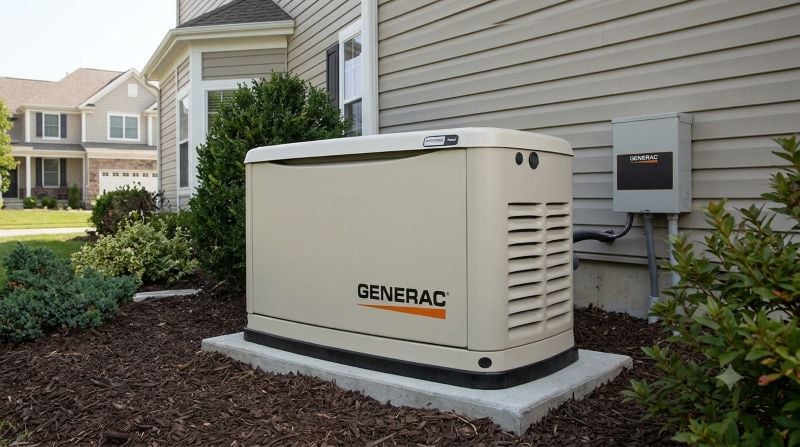
A standby unit converts fuel into electricity through a controlled sequence. It draws in natural gas, burns it to turn a crankshaft, and uses an alternator to produce electrical current. When connected to an automatic transfer switch, the system can detect a utility failure, start automatically, and send backup power to selected circuits or the entire home.
How the System Produces Electricity
A generator powered by natural gas begins with a steady fuel supply from the utility connection. Fuel enters the combustion chamber, where air and gas mix. The spark plugs ignite that mixture, creating controlled explosions that move the pistons.
Like other internal combustion engines, the motor converts combustion into movement. The pistons turn a crankshaft, generating mechanical energy. That rotation drives the alternator, which uses a rotor and stator to create electricity. The current then passes through the control system before reaching the home’s electrical panel.
This process differs from battery storage. A battery releases electricity already stored in its cells, while a generator produces electricity as needed by burning fuel.
What Happens During a Utility Outage?
Most permanently installed systems work with an automatic transfer switch. This device monitors incoming utility voltage and responds when service drops below a safe level.
The normal sequence is:
- The transfer switch detects the interruption.
- The engine starts and reaches a stable speed.
- The switch disconnects the home from the utility grid.
- Backup electricity flows to approved circuits.
- The system reconnects the home after utility service stabilizes.
A generator that runs on natural gas can keep operating without requiring homeowners to refill a portable tank. This makes it useful during extended power outages, provided that gas service remains available.
What Are the Main Parts of a Generator?
Each component handles one stage of the process:
- Engine: Burns fuel and turns the crankshaft.
- Alternator: Converts rotation into electrical current.
- Transfer switch: Safely moves the home between utility and backup power.
- Controller: Starts, monitors, and stops the equipment.
- Battery: Supplies the initial energy needed to start the engine.
- Regulator: Controls fuel pressure before combustion.
The gas line must deliver enough volume and pressure under full load. An undersized connection can cause poor starting, unstable operation, or reduced power output. A licensed contractor or the local gas utility may need to confirm meter capacity before installation begins.
How Do You Choose the Correct Generator Size?
Sizing a natural gas generator requires more than adding the wattage printed on appliance labels. Motors, compressors, pumps, and air conditioners often require additional power for a few seconds when they start.
A contractor should identify:
- Essential circuits, such as refrigeration, lighting, heating, and sump pumps
- Large starting loads, including central air conditioning
- Whether the goal is partial backup or whole-home coverage
- Available service capacity and possible future electrical additions
A smaller system may support only selected circuits. A larger generator on natural gas may operate most household equipment, but it also needs greater fuel volume, more installation space, and a higher-capacity transfer switch.
Before selecting a unit, homeowners can schedule a professional load calculation with Grounded Electric NJ. This helps match generator capacity to actual household demand rather than relying only on square footage.
What Are the Benefits and Limitations?
Natural gas-powered standby equipment offers several practical benefits, but it may not be suitable for every property.
|
Benefit |
Limitation |
|
No liquid fuel storage on the property |
Depends on utility gas availability |
|
Automatic startup during an outage |
Requires professional installation |
|
Suitable for extended operation |
Needs scheduled maintenance |
|
No manual refilling of portable fuel tanks |
May require meter or piping upgrades |
|
Convenient for permanent home backup |
Cannot be moved like a portable unit |
Compared with diesel generators, residential natural gas units usually avoid fuel deliveries and on-site storage. Operating costs depend on fuel rates, electrical demand, engine size, and total runtime. Maintenance expenses and possible gas service upgrades should also be included in the budget.
One limitation is that a natural gas generator can operate only while adequate fuel pressure reaches the engine. Damaged infrastructure, utility restrictions, or other service interruptions can affect operation. Homeowners should consider local gas reliability rather than assume the system can run indefinitely.
What Does Installation Require?
Installing a natural gas standby system involves electrical, fuel, structural, and permit requirements. The unit must be installed outdoors on a stable base and meet the manufacturer’s required clearances from doors, windows, vents, and combustible materials.
Required clearances vary by generator model, manufacturer instructions, and local code. A licensed installer should confirm the approved location before preparing the base, electrical connection, or gas line.
A complete installation usually includes:
- A properly sized fuel connection
- An approved automatic transfer switch
- Electrical conductors and overcurrent protection
- Correct grounding and bonding
- Startup testing and inspection
Never place a fuel-burning generator in a garage, basement, crawl space, or enclosed porch. Generator exhaust contains carbon monoxide and must be directed away from occupied areas, doors, windows, and ventilation openings.
A licensed professional should also confirm that the gas meter, regulator, and piping can support the added load. Skipping this capacity check can affect both the generator and other gas appliances in the home.
How Much Maintenance Does a Generator Need?
A standby system may exercise automatically on a schedule, but self-testing does not replace regular maintenance. Owners should follow the manufacturer’s service intervals for oil, filters, batteries, coolant, and ignition components.
Routine care helps the generator deliver its expected output when needed. It can also identify leaks, weak batteries, blocked airflow, and transfer-switch problems before an outage.
A natural gas generator can provide reliable backup power when it is correctly sized, safely installed, and maintained. The engine, alternator, transfer switch, and fuel system must work together. When the system matches the property’s electrical and fuel requirements, it can restore power automatically and keep essential equipment operating until utility service returns.