It is three days before closing, and an underwriting issue suddenly appears.
The buyer thinks everything is fine. The seller has scheduled the movers. The Realtor wants an immediate answer. The mortgage broker is working to resolve the issue but cannot yet guarantee the loan will close.
This is the moment when the relationship between the mortgage broker and the Realtor will either grow stronger—or begin to fall apart.
Can artificial intelligence help?
Yes, but probably not in the way many people think.
AI cannot approve the loan, make a promise to the buyer, calm an angry Realtor, or decide what to say when the facts are still developing. Those responsibilities remain with the mortgage professional.
AI can help the broker gather information, examine possible outcomes, anticipate questions, prepare a clear explanation, and develop a communication plan. That gives the broker more time to do what matters most: exercise judgment and communicate with the people depending on the transaction.
## The “Agentic” Loan Officer
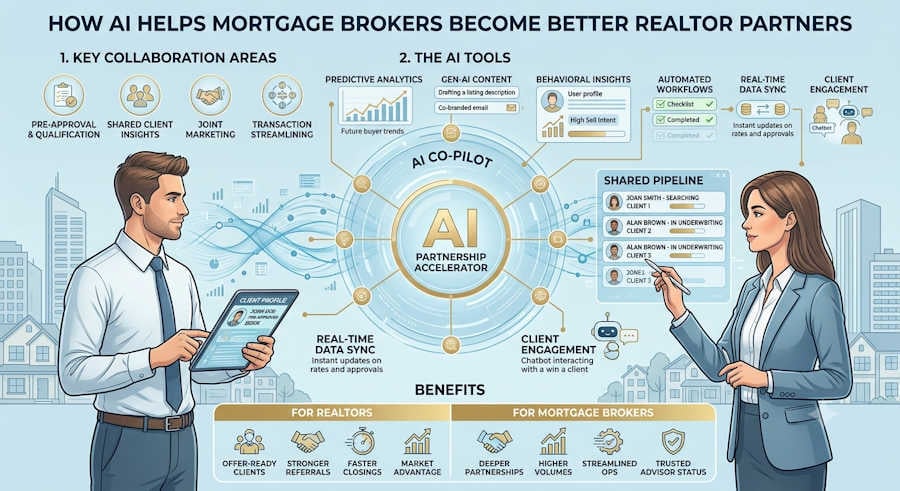
The Mortgage Bankers Association is now offering education about what it calls the **“agentic” loan officer**, describing AI as a co-pilot for residential lending. Its training focuses on defining the business challenge, examining AI applications and use cases, considering risks and measuring results.
That language matters. A co-pilot assists the professional. It does not replace the professional.
Mortgage brokers have traditionally viewed technology as a way to process applications, collect documents, verify information, and move loans through the system faster. Those uses are important, but they are only part of the opportunity.
AI can also help a mortgage broker become a more valuable partner to the Realtor who referred the buyer.
## Helping the Realtor Before a Problem Develops
Every Realtor works differently. Some want frequent status reports. Others want to hear only when a milestone has been reached, or a problem has developed. Some want technical detail. Others want a short explanation they can confidently relay to their buyer.
AI-assisted customer relationship systems can help a broker organize those preferences, review earlier communications and prepare timely follow-ups. Before contacting a Realtor, the broker can quickly see what has already been discussed, what questions remain unanswered and what the next communication should accomplish.
The objective is not to automate the relationship. It is to prevent the relationship from being weakened by missed calls, forgotten details, and inconsistent follow-up.
A Realtor should never have to wonder whether the mortgage broker remembers the buyer—or the Realtor.
## Turning Loan Information Into Useful Communication
Mortgage information can be complicated. Realtors do not need to become underwriters, but they do need enough accurate information to manage the expectations of their buyers and sellers.
AI can help a mortgage broker turn technical information into a concise, understandable update. It can organize milestones, identify missing information, and draft a list of questions the Realtor or buyer is likely to ask.
The broker must still verify every fact and personally approve every message. However, a well-prepared update can be far more useful than a vague assurance that “everything should be fine.”
When there is uncertainty, the message might explain:
* What has happened.
* What is being done about it.
* What information is still needed.
* When will the next update be provided?
* What can and cannot yet be promised.
That is not simply better communication. It is better service at the exact moment when service is being judged.
## Using AI Without Overpromising
One of the biggest risks in mortgage lending is allowing speed to create false certainty.
A buyer wants to know immediately how much house they can afford. A Realtor wants to know whether a difficult loan will close. AI can examine information and generate possible scenarios, but a scenario is not an approval.
The mortgage broker must know where the AI answer ends, and professional responsibility begins.
AI may help the broker prepare several explanations for a developing problem. It may identify questions to ask underwriting or suggest alternatives that warrant investigation. It cannot determine which message is appropriate for this buyer, this Realtor and this moment.
That requires judgment.
## AI Should Strengthen Trust, Not Threaten It
According to the National Association of REALTORS®’ [2025 REALTOR® Technology Survey](https://www.nar.realtor/research-and-statistics/research-reports/realtor-technology-survey), 66% of Realtors adopt technology primarily to save time, while 64% do so to improve the client experience. In addition, 45% reported that their clients responded very positively to technology in the buying and selling process.
Those findings offer mortgage brokers a useful standard. Technology should save time and improve the experience—not make communication colder, less personal or less trustworthy.
Both NAR and the [Mortgage Bankers Association](https://www.mba.org/) are also paying close attention to AI governance, privacy, fair lending, fraud and the growing number of state AI laws. Mortgage professionals must protect confidential borrower information, use approved systems and independently verify AI-generated material.
A faster answer is not better if it is inaccurate, noncompliant or insensitive to the situation.
## The Real Opportunity Is Referral Retention
Mortgage brokers often concentrate on building Realtor referral networks. Building the network is important. Retaining the Realtors who already trust the broker may be even more important.
A Realtor will remember how the broker responded when a buyer became anxious, a document was missing, or a closing appeared to be in danger. That response may determine whether the Realtor makes the next referral.
At AskFletch, I have been studying these moments because they reveal the limits of both traditional training and AI. Once the buyer wants the house and the mortgage, the “sell” is largely over. What remains is service, communication, and judgment.
AI can help mortgage brokers become faster, more organized and better prepared. But its greatest contribution may be helping them create the time and clarity needed to become better human partners.
AI may assist with the loan. The mortgage broker still earns the relationship.

**Primary sources:** [Mortgage Bankers Association—AI education for mortgage professionals](https://www.mba.org/conferences-and-education/education-courses) and [NAR’s 2025 REALTOR® Technology Survey](https://www.nar.realtor/research-and-statistics/research-reports/realtor-technology-survey).