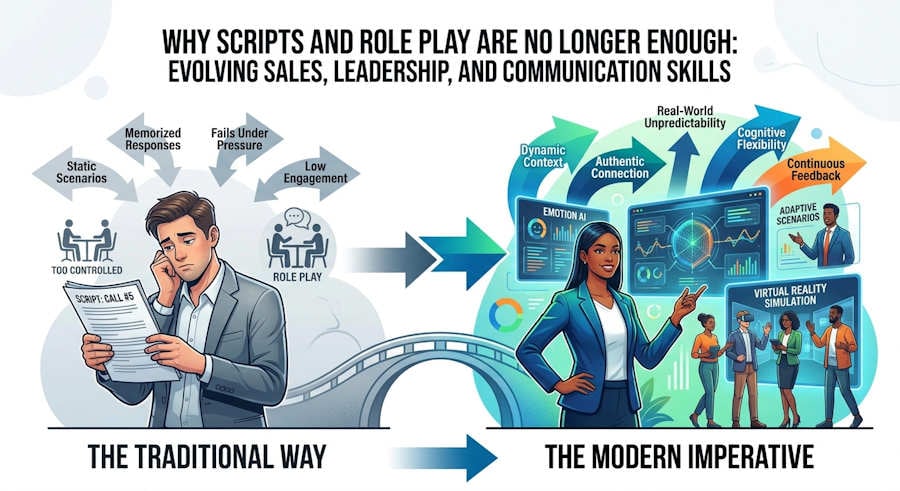
For decades, real estate training followed a familiar formula.
Learn the script.
Practice the script.
Memorize the script.
Role-play the script.
Then, I hope the script works when a real client presents a real objection.
To be fair, that approach has helped thousands of agents improve their communication skills. Learning what to say and how to say it remains valuable.
But something significant has changed.
Artificial intelligence can now generate scripts instantly.
An agent can type a client objection into ChatGPT, Copilot, Gemini, or another AI platform and receive multiple responses within seconds.
The question is no longer whether agents can access scripts.
They can.
The question is whether they know which script to use, when to use it, and whether it addresses the client's actual concern.
That's a judgment issue, not a scripting issue.
The World Has Changed
Imagine a buyer says:
"The kitchen is too small."
Traditionally, a trainer might provide several scripted responses for the agent to memorize.
The agent practices those responses in role-play sessions until they become comfortable delivering them.
That method assumes the objection is about the kitchen.
But what if it isn't?
What if the buyer is worried about entertaining guests?
What if they're concerned about family gatherings?
What if they're comparing the home to another property?
What if they simply need reassurance?
The script may address the stated objection.
Judgment helps uncover the real one.
That's why two agents can hear the exact same objection and achieve very different outcomes.
One responds to the words.
The other responds to the reason behind the words.
AI Has Changed the Value Equation
In the past, training organizations provided tremendous value by giving agents access to information they didn't already possess.
Today, AI provides access to information instantly.
Scripts are abundant.
Talking points are abundant.
Email templates are abundant.
Objection handlers are abundant.
Information is no longer scarce.
Judgment is.
The competitive advantage is shifting away from possessing information and toward evaluating information.
That's a fundamental change.
The Limitation of Traditional Role Play
Role play still has value.
But it also has limitations.
Most role play exercises begin with a trainer already knowing the "correct" answer.
The objective becomes helping the agent discover or repeat that answer.
Real life doesn't work that way.
Clients don't follow scripts.
Markets don't follow scripts.
Unexpected situations don't follow scripts.
Real estate professionals succeed because they learn how to think through situations when no obvious answer exists.
That's where judgment develops.
Not through memorization alone.
But through decision-making.
Learning Through Decisions
Consider how professionals develop expertise in other fields.
Pilots use flight simulators.
Athletes review game situations.
Military leaders study scenarios.
Business executives analyze case studies.
All are practicing decisions.
They are not simply memorizing responses.
They're learning how to evaluate situations, consider alternatives, and choose a course of action.
Real estate professionals face decision points every day.
A buyer hesitates.
A seller resists.
A negotiation stalls.
A transaction encounters a problem.
Success often depends less on having a prepared script and more on understanding how to think through the situation.
The Difference Between Knowing and choosing AI is that it is remarkably good at providing options.
Ask a question, and you'll receive suggestions.
Often several.
Sometimes many.
But AI doesn't choose.
The agent chooses.
That's an important distinction.
The future belongs to professionals who can evaluate information rather than simply collect it.
Agents who can compare alternatives.
Agents who can identify weaknesses in recommendations.
Agents who can recognize when a suggestion fits a situation—and when it doesn't.
These skills are becoming more valuable, not less.
A New Training Opportunity
This doesn't mean scripts should disappear.
Nor does it mean role play has become obsolete.
Both remain useful tools.
The opportunity is to build something on top of them.
Instead of asking only:
"What would you say?"
Training can also ask:
"Why would you say it?"
"What alternatives did you consider?"
"How did AI influence your thinking?"
"What assumptions are you making?"
"What outcome are you trying to achieve?"
Those questions move training beyond communication and into judgment.
That's where professional growth occurs.
What Brokers May Need Most
Many brokers are discovering that recruiting, coaching, and retaining agents requires a deeper understanding of where each agent currently stands.
Not just what they know.
But how do they think?
Two agents may have identical production histories and identical training records.
Yet one consistently makes stronger decisions than the other.
Traditional training often struggles to identify that difference.
Judgment-focused training helps reveal it.
That's valuable information for both the broker and the agent.
The Next Evolution of Real Estate Training: Every generation of technology changes the skills professionals need to master.
AI is no different.
The agents who thrive won't be the ones who simply gather the most information.
They'll be the ones who learn how to evaluate it.
The brokers who succeed won't simply provide more answers.
They'll help agents become better decision-makers.
Scripts still matter.
Role play still matters.
But neither is enough by itself anymore.
Because in the AI era, the most important skill isn't knowing what to say.
It's knowing why.